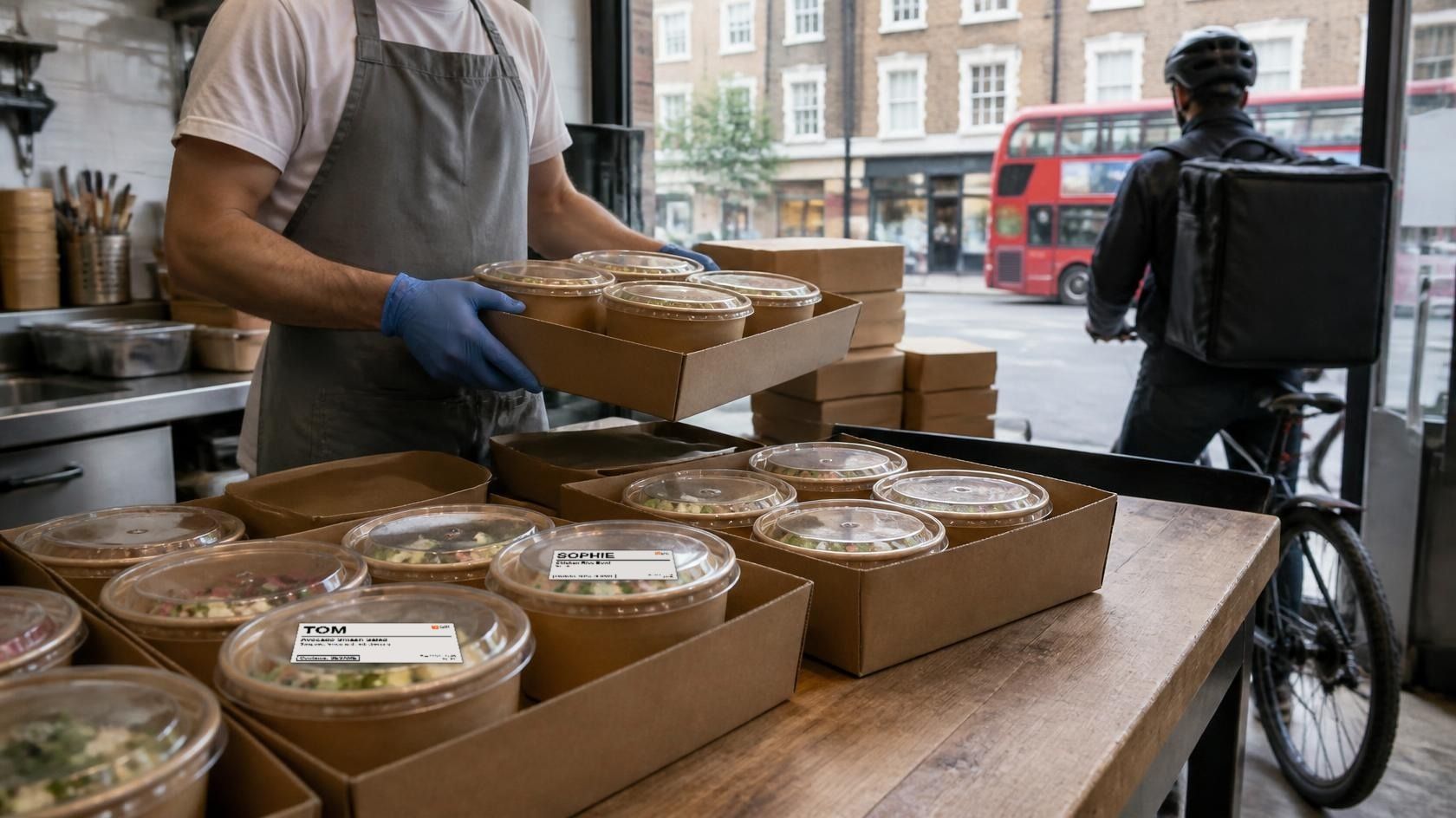
It is 07:40 on a Monday. Your mayonnaise supplier has run out, and the replacement they sent over has mustard in it. That mayonnaise goes into the egg sandwich, the tuna mix, the chicken wrap and two salads. Every site makes them, and the first labels of the day are already printing.
This is the real test of your labelling setup: how quickly does one ingredient change reach every label, at every site?
The FSA's own 2022-23 evaluation of PPDS labelling points the same way. Of the 11% of businesses who still found compliance difficult, 46% named the time taken to introduce and update labelling as a reason (FSA and FSS evaluation). This guide is for ops managers at café groups, food to go chains, bakeries, contract caterers and convenience retailers.
How to choose food labelling software in the UK, in 60 seconds
- Start from the law. A PPDS label must show the name of the food, the full ingredients list and any of the 14 allergens emphasised in that list.
- Allergens should come from ingredients inside recipes, not be typed onto each label by hand.
- Text must print at a minimum x-height of 1.2 mm (0.9 mm only on very small packaging). Check that templates never shrink below it.
- Use by dates should come from shelf lives your business sets, not from a software default.
- One change at head office should reach every site, with a record of who printed what.
- Ask vendors the questions below, then run a two-week trial with five real products, one recipe change, one supplier swap and one Wi-Fi drop.
What UK law makes your labels carry
PPDS rules (Natasha's Law) have applied across the UK since 1 October 2021. For a refresher on what counts, see what PPDS means, or our full guide to Natasha's Law and PPDS labelling.
The FSA's PPDS labelling guidance says the label needs to show three things:
- The name of the food.
- An ingredients list.
- Any of the 14 allergens emphasised in the ingredients list, if they are present.
The 14 are celery, cereals containing gluten, crustaceans, eggs, fish, lupin, milk, molluscs, mustard, peanuts, sesame, soybeans, sulphur dioxide and sulphites (above ten parts per million), and tree nuts. Emphasis can be done "using bold type, capital letters, contrasting colours or through underlining."
Two more rules matter for software:
- Text size. Mandatory information must print with an x-height (the height of a lowercase x) of at least 1.2 mm. If the largest surface of the packaging is under 80 cm2, the minimum is 0.9 mm (Article 13, retained FIC). Our reading is that this refers to the packaging, not the label, so a small label on a sandwich wedge still needs 1.2 mm.
- Changes. The FSA guidance tells businesses to "ensure that you have processes in place to update this information should there be a change in suppliers, or if ingredients change."
Handwritten labels are acceptable if they meet the font size rules, so software is not a legal requirement. But the same evaluation found 64% of businesses labelling PPDS food printed labels in-house, and many interviewed said they had invested in software and hardware to help.
Use by, best before and stock rotation labels
The law: where highly perishable food carries a date, it must be a use by date, and after it the food is deemed unsafe. FSA Safer Food Better Business (SFBB) is blunt: "It is against the law to serve food after its 'use by' date." Use by is about safety. Best before is about quality.
The good practice: SFBB asks you to follow "first in, first out", to note the name, ingredients and date when you decant food into another container, and to label frozen food with the date it was frozen. More on this in our guide to stock rotation labels in UK kitchens.
The PPDS rules do not list a use by date among the three required items, and we have not verified whether one is legally required on PPDS food. Adding one is good practice. We found no FSA default shelf life for food made in-house either. Shelf lives come from your own food safety management system, not from software.
Price marking for convenience retailers
If you print shelf-edge or price labels, the Price Marking Order 2004 amendments took effect on 6 April 2026. Unit prices must include VAT, and a product with more than one price, such as a loyalty price, must show each selling price and unit price. This does not change PPDS labels. Read the DBT guidance for the detail, and ask vendors whether they print shelf-edge labels at all.
From law to features
- Allergens built from ingredients. Allergens should be stored on ingredients, and recipes should pull them through.
- One ingredient record, used everywhere. Change the mayonnaise once and every recipe that uses it should change, with a history of who changed it and when.
- Compound ingredients broken down. Allergens inside bread or mayonnaise must show on the final label.
- Templates that respect x-height. A long ingredients list should trigger a warning, not shrink below 1.2 mm.
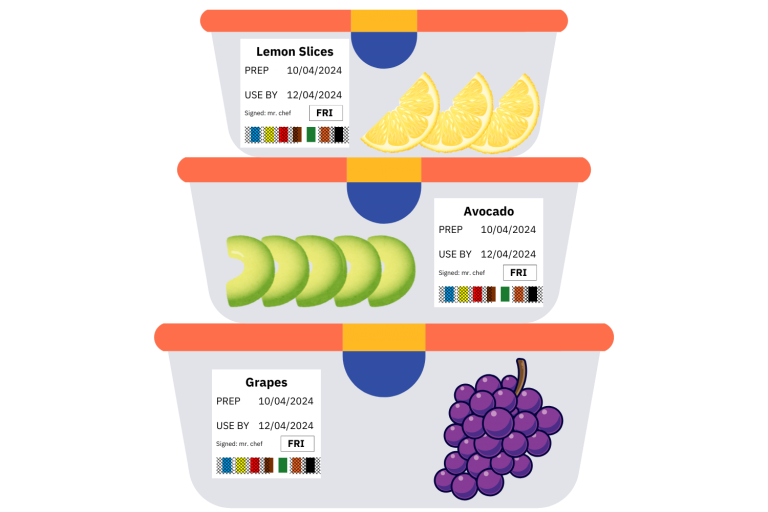
- Shelf life set by you. Use by dates calculated from shelf lives you enter, printed with prep date and initials.
- Written allergen information without printing. FSA best practice guidance says written allergen information for non-prepacked food should be easily available, on paper or digitally. Staff should be able to view the same recipe data.
- Central control for multiple sites. Head office owns recipes, sites print.
- An audit trail. Who printed what, where and when, ready for an EHO.
- Kitchen reality. Printing from phones and tablets, offline printing, printers you can actually buy, and the label sizes you use (2x4in and 2x2in are common).
- POS or EPOS links. Products pulled from till data rather than retyped.
Why it matters: in the evaluation, close to nine in ten local authorities had seen PPDS food with no labels, and more than four fifths had seen incomplete ingredients lists. That is the share of authorities that saw it at least once, not a share of labels.
Two labels your software must get right
Use these as demo test cases. Ingredients are illustrative; real labels must come from your own recipes and supplier specs.
Example 1: PPDS label, 2x4in (about 51 x 102 mm)
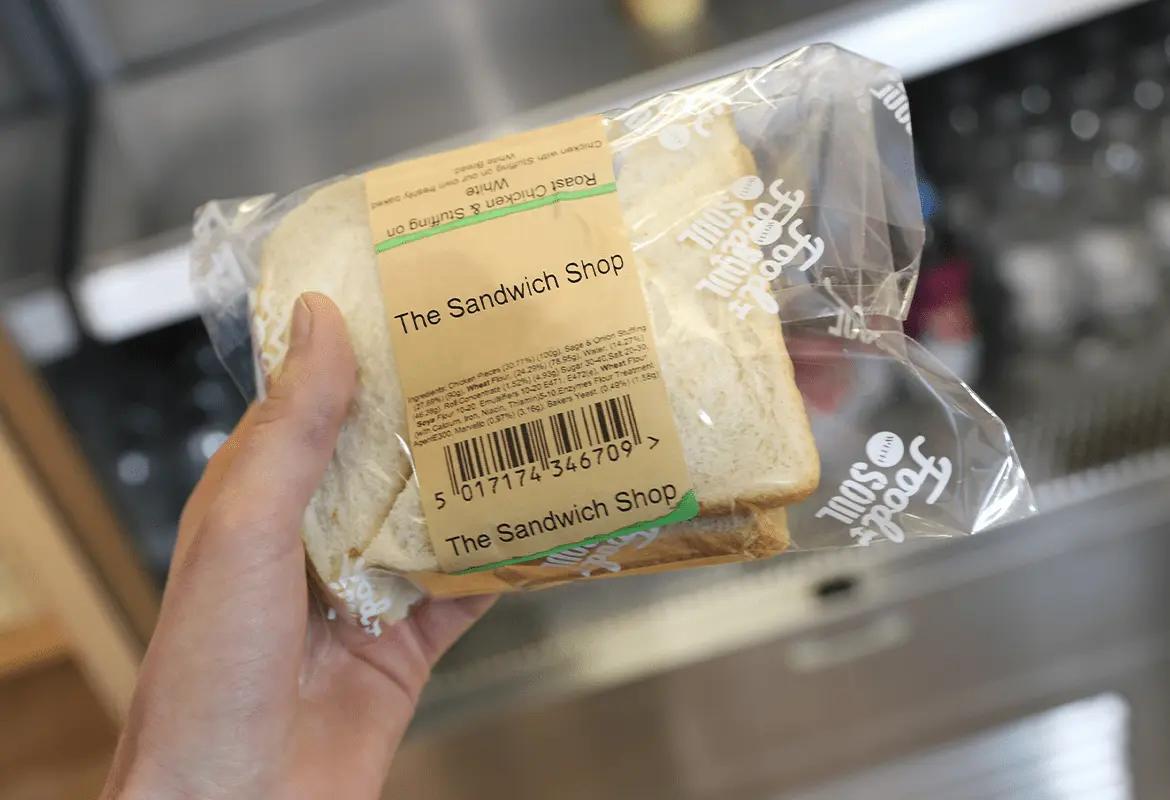
EGG MAYONNAISE SANDWICH ON WHITE BREAD
Ingredients: White bread (WHEAT flour (WHEAT flour, calcium carbonate, iron, niacin, thiamin), water, yeast, salt, rapeseed oil), free range EGG, mayonnaise (rapeseed oil, water, pasteurised EGG yolk, spirit vinegar, salt, MUSTARD seed), cress, black pepper.
For allergens, see ingredients in BOLD CAPITALS.
Use by: 27/10/2026
Keep refrigerated.
Made on site at [Café name, address]
What to check: every allergen emphasised each time it appears, with bread and mayonnaise broken down so the wheat, egg and mustard inside are visible. Wheat is named, not just "gluten". No "Contains:" box is needed because there is an ingredients list. Use by, storage and business name are good practice, not PPDS requirements. Measure the printed text against 1.2 mm.
Example 2: Stock rotation or prep label, 2x2in (about 51 x 51 mm)
TUNA MAYO (PREP)
Prepared: 26/10/2026 08:15
Use by: 28/10/2026 end of day
By: JM
Allergens: FISH, EGG, MUSTARD
Keep refrigerated
What to check: prep date and time, use by and initials support first in, first out. The allergen line helps staff, but this is not a customer label: packed for sale, the tuna mayo needs a full PPDS label like Example 1. The two-day shelf life is illustrative; your food safety management system sets it.
Questions to ask any food labelling software vendor
Ask them to show you, not tell you.
- If I change one ingredient, which labels change, and how fast does it reach every site?
- Show me a supplier swap updating every affected product, live.
- What happens when an ingredients list is too long for a 2x4in label? Does text ever shrink below 1.2 mm x-height?
- Where does the use by date come from, and who can change a shelf life?
- Can a site edit a recipe locally? Who approves it?
- Can staff show a customer the allergens for an item without printing a label?
- Can I export print history for one site for last Tuesday?
- What happens if the Wi-Fi drops mid-service?
- Which devices do staff print from, which printers are supported, and which label sizes?
- Which POS or EPOS systems do you connect to, and what syncs?
- How long does setup take, and who does the data entry?
- Can I use printers I already own? What are the contract term, notice period and support hours?
If a vendor promises "full compliance", ask what they mean. Software can make correct labels easier. It cannot make your recipes, supplier specs or shelf lives correct for you.
A two-week trial plan
Run every shortlisted system through the same trial. Write down your pass and fail criteria before day one.
- Days 1-2: load five real products. Pick ones that stress the system: one with a compound ingredient like bread, one with three or more allergens, one with a long ingredients list, one prep or rotation item, and one hot or made-to-order item. Record how long setup takes.
- Days 3-7: print in live service. Staff use their real devices, during real rushes. Check every label against the recipe sheet and the three PPDS items. Measure the x-height on a printed label.
- Day 8: recipe change. Add an allergen to one ingredient, for example switch to a mayonnaise containing mustard. Count how many products and sites updated, and time it.
- Day 9: supplier swap. Replace one ingredient with another supplier's version with different sub-ingredients. Confirm every product using it changed.
- Day 10: offline test. Disconnect the Wi-Fi and try to print.
- Days 11-14: the boring bits. Pull the print history for one site. Ask support a real question at a busy time. Read the contract for term, notice and hardware ownership. Then decide against your written criteria.
Days 8 and 9 are your Monday morning. In food to go allergen labelling, the first label is easy. The hard part is keeping the hundredth one right.
What's still unclear
- The FSA's best practice guidance on non-prepacked allergen information, published in February 2025, was due for review in September 2026. Check the page for the current version.
- We have not verified whether a use by date is legally required on PPDS food. Treat it as good practice.
- Whether the 80 cm2 threshold ever helps a small label on a larger pack is our reading of Article 13, not FSA wording.
- The FSA evaluation figures are self-reported and come from 2022-23, early in the regime.
How Dill handles it
Dill keeps recipes, ingredients, allergens and shelf lives in one place. Staff pick the item on a tablet or phone, on iOS and Android, and the label prints with the right allergens, dates and who made it. A change made once reaches every site, so the Monday mayonnaise swap is one edit. Dill connects to POS and EPOS data (Clover, Lightspeed, EposNow, CyBake, PosHub), so products are not retyped, and prints prep and rotation, grab-and-go and made-to-order labels. It runs on Brother label printers, with other hardware on request. Today that is hundreds of businesses, thousands of sites between them, and over 65 million labels printed.
Book a demo and bring your trickiest product.
FAQ
Do I legally need food labelling software in the UK?
No. The law sets what the label must show, not how you make it, and handwritten labels are acceptable if they meet the font size rules. Software helps most when you have many products, many sites or frequent recipe changes.
What must a PPDS label show?
The name of the food, a full ingredients list, and any of the 14 allergens emphasised within that list. Emphasis can be bold, capitals, contrasting colours or underlining.
What is the minimum text size on a food label?
Mandatory information needs an x-height of at least 1.2 mm. Where the largest surface of the packaging is under 80 cm2, the minimum is 0.9 mm.
Should labelling software set my shelf lives?
No. Shelf lives should come from your own food safety management system. Good software applies the shelf life you set and prints the use by date from it.
Does a PPDS label need a use by date?
The PPDS rules list name, ingredients and emphasised allergens only, and we have not verified a legal requirement for a use by date on PPDS food. Adding one is good food safety practice.
Do the April 2026 price marking changes affect my food labels?
Not your PPDS labels. They apply to price indications, so they mainly matter to convenience retailers printing shelf-edge or price labels.