Saturday, half twelve, and the deli counter queue is out the door. A customer points at the coronation chicken and asks: "Does that have nuts in it?" The person behind the counter started on Thursday. The recipe is in the kitchen, the supervisor is on the till, and there is nothing written next to the tub.
The law sets a minimum for loose food. The Food Standards Agency (FSA) has published best practice that goes further. This post covers both, then what each looks like at a café, a deli or bakery counter, a buffet and a specials board.
Allergen information for loose food in 60 seconds
- If you sell food that is not prepacked, you must give allergen information for the whole dish as served.
- In England, Wales and Scotland that information can be given out loud, as long as a written sign tells customers to ask staff.
- The FSA's best practice guidance, published in early 2025, recommends written allergen information that customers can see without asking, backed by a conversation with staff.
- On counters and buffets, the practical answer is a small ticket next to each item, plus signposting and trained staff.
- "May contain" is voluntary and should only appear after a risk assessment finds an unavoidable risk.
- Food packed at the customer's request follows the loose food rules. Food packed in advance for self-selection is PPDS and needs a full ingredients label.
What the law requires for loose food
For non-prepacked food, giving allergen information is mandatory under Article 44(1)(a) of the assimilated Food Information Regulation (Regulation 1169/2011). The allergens are the 14 you already know: celery, cereals containing gluten, crustaceans, eggs, fish, lupin, milk, molluscs, mustard, tree nuts, peanuts, sesame, soybeans and sulphur dioxide/sulphites.
In England, regulation 5 of the Food Information Regulations 2014 lets you provide that information "by any means the operator chooses, including... orally." If you rely on staff telling customers, you must indicate that details "can be obtained by asking a member of staff". That indication has to be on a label attached to the food, or on a notice, menu, ticket or label "readily discernible by an intending purchaser".
Wales and Scotland have their own 2014 regulations with the same oral plus signposting structure. Scotland's regulation 5 expressly covers food "packed on the operator's premises at the consumer's request". Northern Ireland has its own regulations too.
Two points from the FSA's technical guidance:
- Allergen information "must be made available for the entire dish as served". A sauce, a garnish or a dressing counts.
- On buffets, information "should be provided for each food item separately".
What the law does not ask for, on loose food, is a full ingredients list. That only comes in with PPDS, covered below.
What the FSA's best practice guidance adds
The FSA's guidance, Allergen information for non-prepacked foods: best practice, was published in early 2025 and applies to England, Wales and Northern Ireland. It says plainly: "You are not required by law to follow best practice guidance." As of 23/11/2026, the published guidance is still the early 2025 version, even though its review date was September 2026.
Its central recommendation is that "written allergen information should be readily available, if possible, without consumers having to ask for it", backed by a conversation where staff confirm the dish suits that person.
In FSA research published in October 2025, 25% of adults with a food hypersensitivity said they saw no allergen information the last time they ate out or got a takeaway, even though 94% of the 520 food service workers surveyed said their business provides it in writing. The places it most easily goes missing are the counter, the buffet and the specials board.
For the menu side and the campaign behind the push for written information, see our post on Owen's Law and allergens on menus.
Written formats by setting
The guidance allows words, or symbols with words alongside. Symbols need a name or a key. In words, name the specific nut or cereal (almond, wheat), not just "nuts" or "gluten". The FSA offers free allergen icons and signs to download, and an example allergen matrix.
Café: menu and wall matrix
The guidance suggests the "main menu (paper or digital), allergen booklet on a counter or matrix displayed on a wall". For a café with a fixed menu, a wall matrix near the till covers the whole range in one place. Keep it to the dishes you actually sell this week.
Deli and bakery counters: tickets next to the food
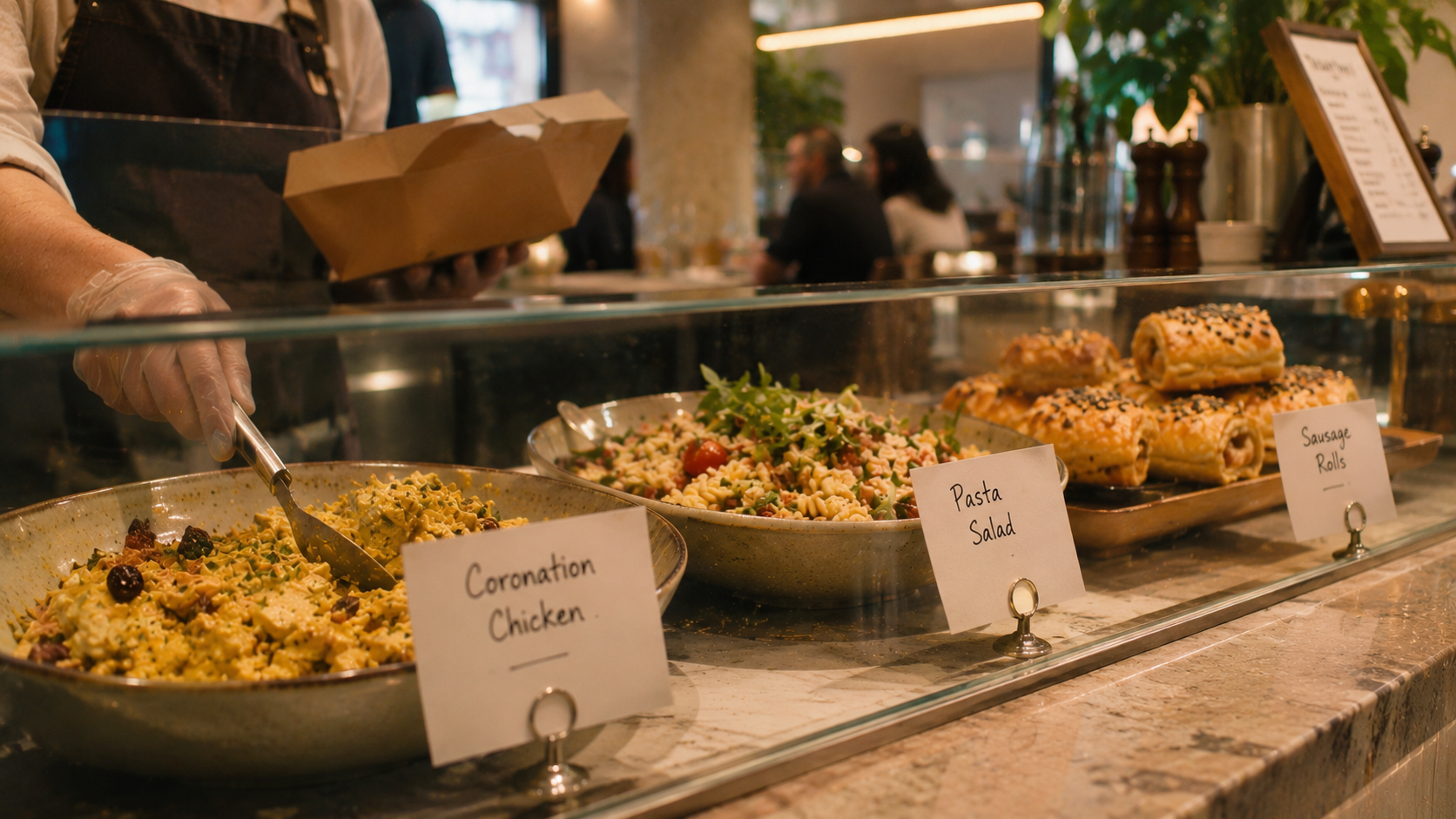
For counters, the guidance points to "a label placed next to the food where consumers choose from a counter or similar". A small ticket in front of each tray means the new starter reads it instead of guessing.
Here is a 2x1in counter ticket (ingredients illustrative):
CORONATION CHICKEN
Contains: Milk, Egg, Mustard, Celery, Sulphites
Allergies? Please ask staff.
Buffets: one ticket per item
One board listing every allergen somewhere on the table does not help anyone choose. Put a ticket at each dish.
A 2x1in buffet ticket (ingredients illustrative):
CHICKEN CAESAR WRAP
Contains: Wheat (gluten), Egg, Milk, Fish (anchovy), Mustard
Allergies? Please ask staff.
Buffets also raise cross-contact, since customers move serving spoons between dishes. Factor that into your risk assessment.
Specials boards
Specials change daily, which is when allergen information goes missing. Write the allergens on the board next to each special, or keep a printed sheet for today's specials beside the till. Whoever writes the board should work from the recipe, not memory.
Phone and online orders
If you take orders by phone or online for non-prepacked food, the technical guidance says mandatory allergen information must be available free of charge before the purchase is concluded and at the moment of delivery. We cover this in detail in allergen labelling for delivery orders.
Signposting wording you can use
If any part of your allergen information is oral, your sign has to tell customers to ask a member of staff. Wording that follows regulation 5:
Food allergies or intolerances? Details of the allergens in our food are available from a member of staff, please ask before you order.
Examples from the FSA guidance itself:
- "We have a menu with allergen information, please speak to staff who will be happy to provide it."
- "Please talk to us if you have a food allergy, intolerance or coeliac disease. We want to cater safely for everyone."
Put the sign where customers see it before ordering. For the conversation itself, the guidance says asking customers whether they have "any allergen requirements" is suitable, and the server should verbally confirm the food meets the requirement when it is handed over.
"May contain" on loose food
Precautionary allergen labelling ("may contain") is voluntary. The technical guidance says it should be used only "if an unavoidable risk of allergen cross-contamination has been identified following a risk assessment". The best practice guidance adds that cross-contact "should also be considered" when you give allergen information.
So "may contain mustard" on ham is fine if it shares a slicer with mustard-glazed meat and you have assessed that risk as unavoidable. "May contain nuts" on everything as blanket cover takes choices away from allergic customers for no reason.
Keeping allergen information accurate when recipes change
The written ticket is only as good as the recipe behind it. The best practice guidance says businesses "should have procedures in place to ensure that their allergen information is accurate". In practice:
- Keep recipe records. The guidance recommends "a record of recipes so they are made to the same specification each time".
- Avoid last-minute substitutions. The guidance asks businesses to minimise them. A swapped mayonnaise can bring in a new allergen; if it has to happen, update the ticket first.
- Check supplier changes. When a supplier changes a product or you change supplier, check the new spec and update every recipe that uses it.
- Staff should not guess. The guidance says that if accurate information cannot be given, the business must tell the customer.
- Pass allergy requests to the kitchen in writing. The guidance says customer allergy information should go to the person preparing the food in writing, not shouted across the pass.
- Train for the conversation. The FSA says businesses must make sure staff receive allergen training, and the best practice guidance says they should be "sufficiently trained to have a conversation about allergens".
Loose, packed at request, or PPDS?
The same product can fall under different rules depending on when it was packed.
- Loose: sold unwrapped from a counter, buffet or menu. Allergen information required, can be oral with signposting.
- Packed at the customer's request: the customer asks, you slice and wrap. The technical guidance says this "is covered by the same rules" as non-prepacked food. Allergen information is required, a full ingredients list is not.
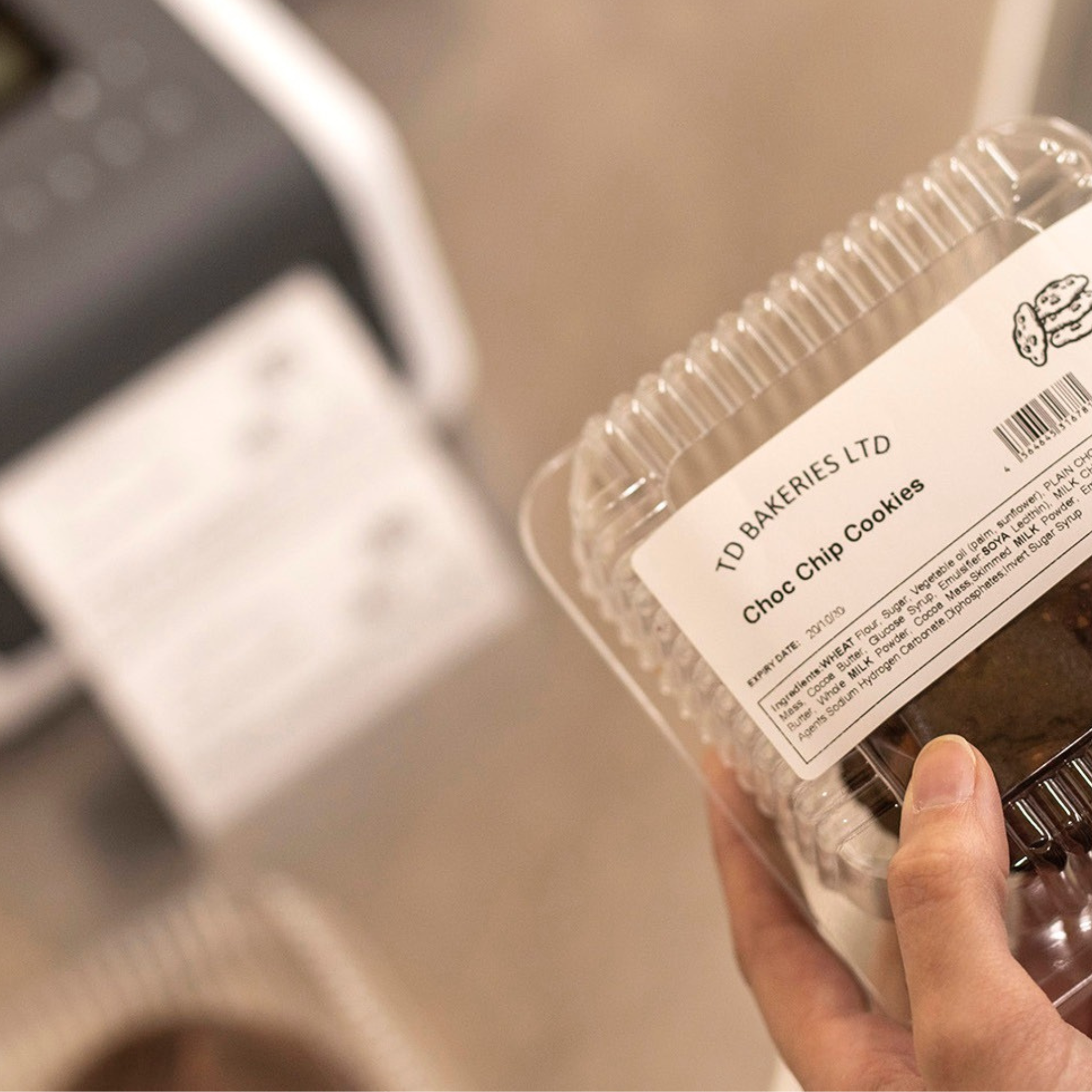
- Prepacked for direct sale (PPDS): packed on the premises before the customer orders, for them to pick up themselves. The FSA says PPDS foods need a label with the name and "a full ingredients list with allergenic ingredients emphasised within it". This is Natasha's Law, and it is the food to go allergen labelling most grab-and-go operators already know.
A 2x4in label for ham sliced to order (ingredients illustrative):
SMOKED HAM & MATURE CHEDDAR (SLICED TO ORDER)
Contains: Milk
May contain: Mustard (prepared on a shared slicer)
Packed at your request on 23/11
Full allergen information is available from staff.
The "may contain" line only belongs there if a risk assessment found an unavoidable risk.
If that same ham and cheddar is sliced at 8am, wrapped and put in the chiller for customers to help themselves, it is PPDS. It then needs the product name and a full ingredients list with allergens emphasised, for example "Smoked ham (pork, salt, preservative: sodium nitrite), mature Cheddar cheese (milk)". More on what that label needs on our Natasha's Law and PPDS page.
What's still unclear
- The review: the September 2026 review date has passed with no new version published. We do not know whether changes are coming or when.
- Scotland: the best practice guidance covers England, Wales and Northern Ireland. Food Standards Scotland consulted from 23/02 to 17/05/2026 on written allergen and ingredient information, as guidance rather than law. The consultation has closed and no outcome has been published yet.
How Dill handles it
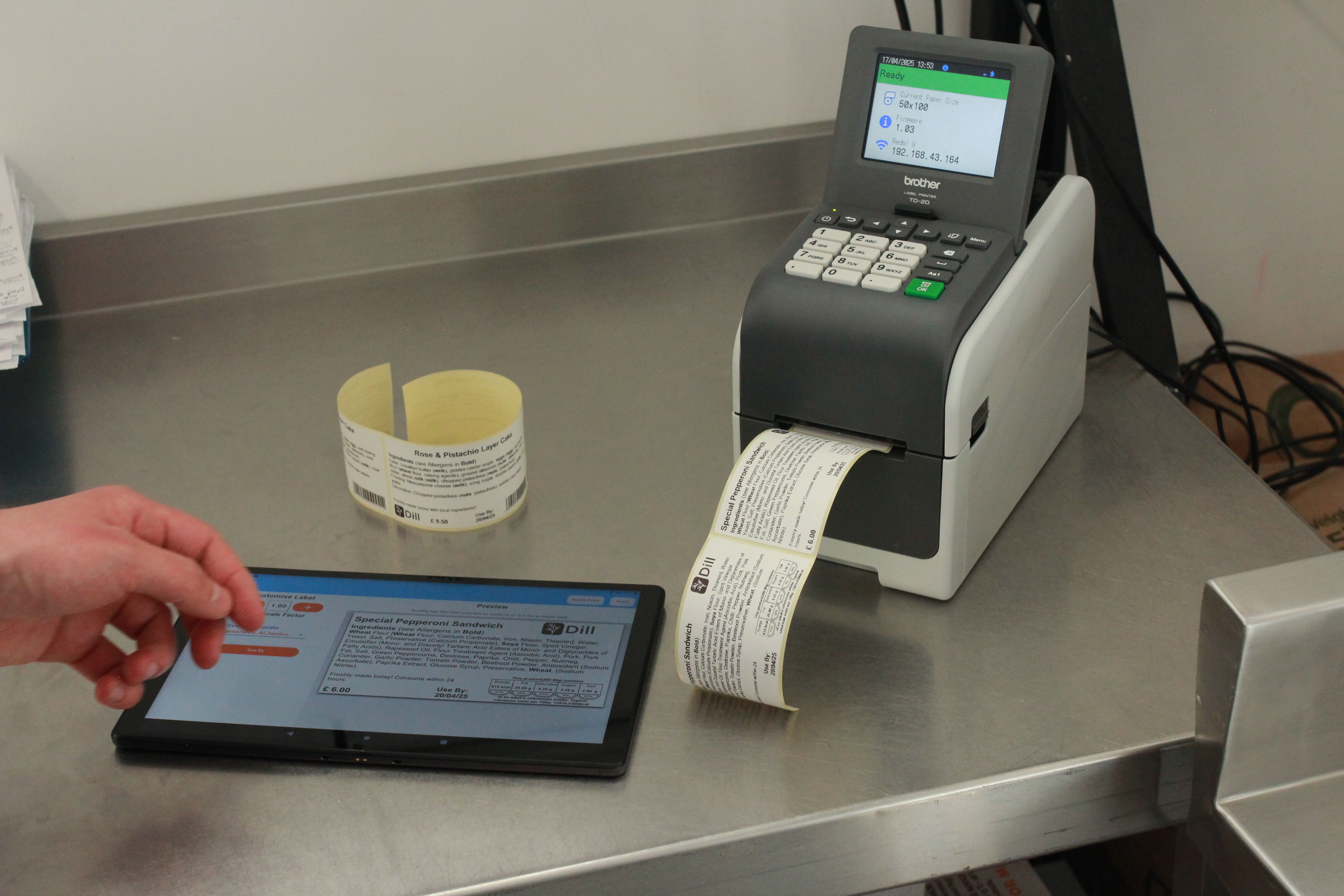
Dill keeps recipes, ingredients, allergens and shelf lives in one place. Recipes are built from ingredients, so when a supplier changes a product, updating the ingredient updates every recipe that uses it. Staff pick the item on a tablet or phone (iOS and Android) and the label prints with the right allergens, dates and who made it, whether that is a shelf-edge ticket, a made-to-order label or a grab-and-go label. A change made once reaches every site. Dill connects to POS/EPOS data (Clover, Lightspeed, EposNow, CyBake, PosHub), so products aren't retyped, and runs on Brother label printers, with other hardware on request. The numbers so far: hundreds of businesses, thousands of sites between them, and over 65 million labels printed.
Book a demo to see how it works for your store.
FAQ
Can allergen information for loose food be given verbally?
Yes. In England, Wales and Scotland the law allows oral allergen information, as long as a written notice, menu, ticket or label tells customers they can ask a member of staff.
Is the FSA's best practice guidance a legal requirement?
No. The guidance says you are not required by law to follow it. The legal minimum is unchanged, but the FSA recommends written information that customers can see without asking.
Do I need allergen labels on every item on a buffet?
The FSA's technical guidance says allergen information should be provided for each buffet item separately. A ticket at each dish is the simplest way to do that.
Do I need a full ingredients list for food sold loose?
No. For loose food and food packed at the customer's request, the requirement is allergen information. A full ingredients list is needed for PPDS food.
When should I use "may contain" on loose food?
Only when a risk assessment has found an unavoidable risk of cross-contact. It is voluntary and should not be used as blanket cover.
Has the FSA updated its best practice guidance in 2026?
Not yet. The guidance named September 2026 as its next review date, but no revised version had been published as of 23/11/2026.
What should staff do if they don't know the allergens in a dish?
They should not guess. Check the recipe or ask someone who knows, and if accurate information cannot be given, tell the customer.