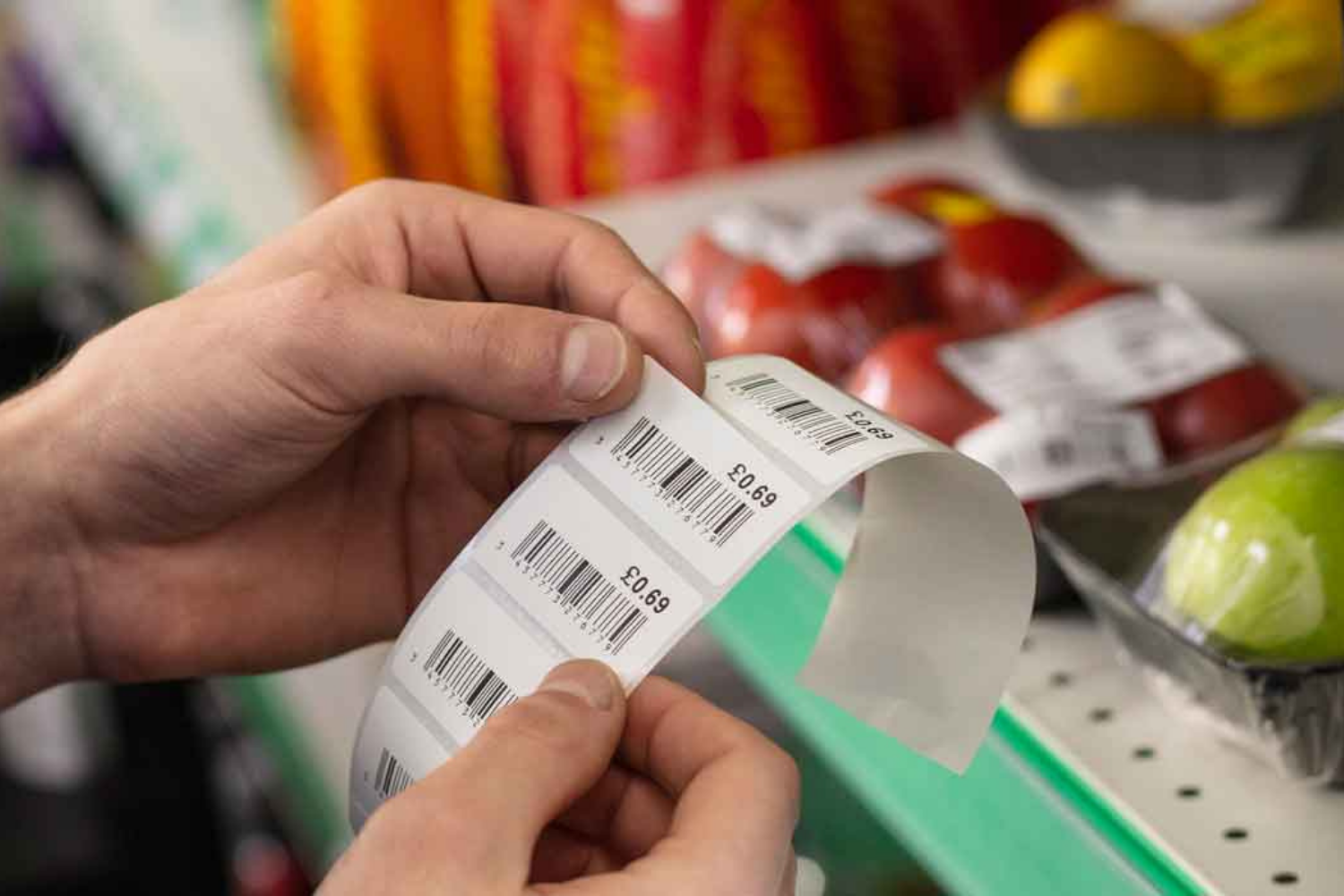
It's 7am and the manager of a convenience store is walking the drinks aisle with a stack of freshly printed shelf-edge labels. The apple juice has a member price this week. Two aisles over, the crisps are on 2 for £2.50. Each label is about two inches by one, and since 06/04/2026 each one has more work to do.
Two orders, S.I. 2024/1055 and S.I. 2025/592, amended the Price Marking Order 2004 from 06/04/2026. Here's what that means for convenience stores, food to go retailers, farm shops, delis and grocers who print their own tickets.
Price Marking Order 2026 in 60 seconds
- Unit prices are per kg, per litre or per item. The old product-specific units are gone.
- Unit prices include VAT and exclude any deposit.
- A loyalty price means showing every selling price and every unit price, plus the conditions.
- For multibuys, show both the single and the offer unit price.
- Loose goods need a unit price, even in a small shop.
- The 280 sq m small shop exemption only covers constant-quantity prepacks and prescribed-quantity bread.
- Trading standards can prosecute, and the CMA can fine directly under the DMCC Act 2024.
What changed on 06/04/2026
The 2024 amending order was originally due to start on 01/10/2025. The 2025 amending order came into force on 30/09/2025 and pushed that date back to 06/04/2026. The government guidance confirms: "The amendments made by both these orders come into effect on 6 April 2026."
For shelf-edge labels, the main changes are:
- Standard units. The unit price is for one item where the product is sold by number, and for one kilogram or one litre (or metre, square metre, cubic metre) in other cases. Schedule 1, the old list of product-specific units, was removed. In practice, per 100 g or per 100 ml is no longer the required unit for any product.
- VAT in, deposits out. The Order's definition is "the final price, including VAT and all other taxes (but excluding the amount of any deposit)". If a drink carries a deposit, keep it out of both the selling price and the unit price.
- More than one price. New Article 7A covers loyalty, membership and app prices (more below).
- Reductions. Article 9, on general reduction notices, was rewritten.
- Legibility. Prices must use "a font which is clear and of reasonable size".
Which goods need a unit price at all? Goods sold from bulk, and goods that weights and measures or food information law requires to carry a quantity marking. Products where the unit price equals the selling price are exempt.
Loyalty and member prices: Article 7A
If you sell a product at more than one selling price, the Order says you must show "each selling price and each unit price applicable to the product", and "the trader must prominently display those conditions".
The Order also requires them "in close proximity to the product". The guidance's worked example is £2 standard and £1 with a loyalty card, using wording such as "with loyalty card".
On a 51 x 25 mm label, that means four numbers and a condition. "Ask for terms" is fine as an extra, but it can't replace stating the condition itself.
Multibuys and reductions
This is where the two guidance sources disagree. The gov.uk guidance works through crisps at £2 each or 2 for £3, and says "the 'offer' selling and unit price would need to be displayed". Its cat food example (£4 each or 2 for £7) says "both the individual and the offer selling and unit price would need displaying".
Business Companion, the trading standards guidance site, puts it differently: "Promotional offers must be unit-priced to reflect the single standard item," and retailers "may give additional information if they wish".
The safe route is to show both: the single-item price and unit price, and the offer price and offer unit price. That satisfies either reading.
Mixed bundles are different. Under the replaced Schedule 2 paragraph 3, an assortment of items sold by different measures, or at different prices outside the bundle, doesn't need a unit price. A meal deal may fall under this.
Where re-marking every item isn't reasonably practicable, a general notice can replace it, "provided that the details of the reduction are prominently displayed, unambiguous, easily identifiable and clearly legible." Goods reduced because of damage or "the danger of its deterioration" are exempt from unit pricing, so reduced-to-clear stickers on short-dated food don't need one.
Loose goods: deli counters, farm shop veg, pick and mix
Goods sold from bulk are not pre-packaged and are weighed or measured at the customer's request: deli olives, farm shop potatoes, loose sweets.
For these, a selling price isn't required on the shelf label, because the price is worked out at the scale. The unit price is required, in small shops too. Two more unit price rules:
- Rounding. "Where the unit price of a product falls below £1 it shall be expressed to the nearest 0.1p." Above £1, it may be to the nearest penny.
- Drained weight. For prepacked solid food in liquid, "the unit price shall refer to the net drained weight of the product."
The 280 sq m small shop exemption
A small shop is one with a relevant floor area "not exceeding 280 square metres". Exactly 280 sq m still counts as small. The floor area is the internal area used for retail sale or for displaying products for sale, so stockrooms and back offices don't count.
Here's what the exemption covers, according to the Order:
- products "pre-packaged in a constant quantity" for sale in a small shop
- "bread made up in a prescribed quantity" for sale in a small shop
Here's what it doesn't cover:
- Loose goods. The guidance says: "Note that this exception does not apply to products sold from bulk."
- Shops over 280 sq m. The guidance example is a 290 sq m shop, which must show both selling price and unit price.
- Prepacked variable-quantity goods, probably. The exemption only names constant-quantity prepacks, so a hand-cut cheese wedge priced by its weight doesn't appear to be covered. That's our reading of the wording, not a guidance quote.
You'll see a broader version online: that small shops don't need unit prices at all. That's wider than the Order, so don't rely on it. Showing a unit price on exempt lines is still allowed and helps customers compare.
Making a small label legible
There's no minimum point size in the law or the guidance. The Order requires prices to be "so placed as to be available to consumers without the need for them to seek assistance". The guidance suggests "as large a letter height as possible with adequate spacing" and notes "The unit price may be a smaller size than the selling price".
On a small label: product name and size on top, selling price biggest, unit price beside or below it, code and date small at the bottom. Bold and size do the work.
Four worked shelf-edge labels
These are 2x1in labels (about 51 x 25 mm), printed in black. Products and prices are illustrative.
Example 1: standard prepack, shop over 280 sq m
OAT BISCUITS 300g
£1.80
£6.00 per kg
Code 10234 09/11/26
£1.80 / 0.300 kg = £6.00 per kg, VAT included. A small shop could skip the unit price here, but showing it is allowed.
Example 2: loose goods, priced per kg
MIXED OLIVES, LOOSE
£22.00 per kg
Weighed at the counter
Code 20511 09/11/26
No selling price is needed on the label: a 250 g tub comes to 0.250 x £22.00 = £5.50 at the scale. This applies in small shops too. Carrots at 84p per kg would show as "84.0p per kg" (under £1, nearest 0.1p).
Example 3: loyalty price
APPLE JUICE 750ml
£2.25 £3.00 per litre
MEMBER PRICE £1.80 £2.40 per litre
With [shop] loyalty card. Ask for terms.
£2.25 / 0.75 l = £3.00 per litre. £1.80 / 0.75 l = £2.40 per litre.
Example 4: multibuy on identical items
SEA SALT CRISPS 150g
£1.50 each £10.00 per kg
2 FOR £2.50 £8.33 per kg
Offer ends 22/11/26
Single: £1.50 / 0.150 kg = £10.00 per kg. Offer: £2.50 / 0.300 kg = £8.333 per kg, shown as £8.33 (over £1, nearest penny permitted). Both unit prices are shown, so it works under either guidance wording.
Shelf-edge label checklist
- Unit price per kg, per litre or per item. Not per 100 g as the required figure.
- VAT included in selling and unit price. Any deposit shown separately, never inside either price.
- Every price on the label has its own unit price: standard, member and offer.
- Conditions for a member or offer price printed on or right next to the label.
- Loose goods show a per kg price, even in a small shop.
- Small shop exemption checked against retail and display floor area only, and applied only to constant-quantity prepacks.
- Rounding: under £1 to 0.1p, over £1 to the penny.
- Drained weight used for solid food in liquid.
- Readable without asking staff. Selling price largest, unit price may be smaller.
- Reductions shown clearly on the label, or by a general notice where re-marking each item isn't practicable.
Who enforces it, and the penalties
The PMO applies to Great Britain. Northern Ireland has its own order.
Criminal enforcement "may only be undertaken by trading standards", and a trader found in breach is liable to "a fine of an unlimited amount".
The PMO is also listed in Schedule 16 to the Digital Markets, Competition and Consumers Act 2024. That means the CMA can enforce the PMO directly, without having to go to court, and impose fines "of up to £300,000 or 10% of the trader's global turnover (whichever is higher)". The guidance gives no start date for these powers.
What's still unclear
- Multibuy unit prices. The two guidance sources are worded differently. Show both unit prices.
- Per 100 g as an extra. Nothing we found bans adding it alongside per kg, and nothing permits it. Keep per kg or per litre as the main figure.
- Food to go items sold by number. Whether a sandwich or pastry needs a unit price depends on whether the law requires a quantity marking for it. If it's sold by number, the unit price equals the selling price and is exempt. We haven't checked this item by item, so ask your local trading standards.
- Prepacked variable-quantity goods in small shops. The exemption names only constant-quantity prepacks. No guidance addresses the rest directly.
- Floor area with seating. How a cafe area counts toward the 280 sq m wasn't confirmed.
- Guidance updates. The gov.uk guidance can change. Re-check it before you redesign your labels.
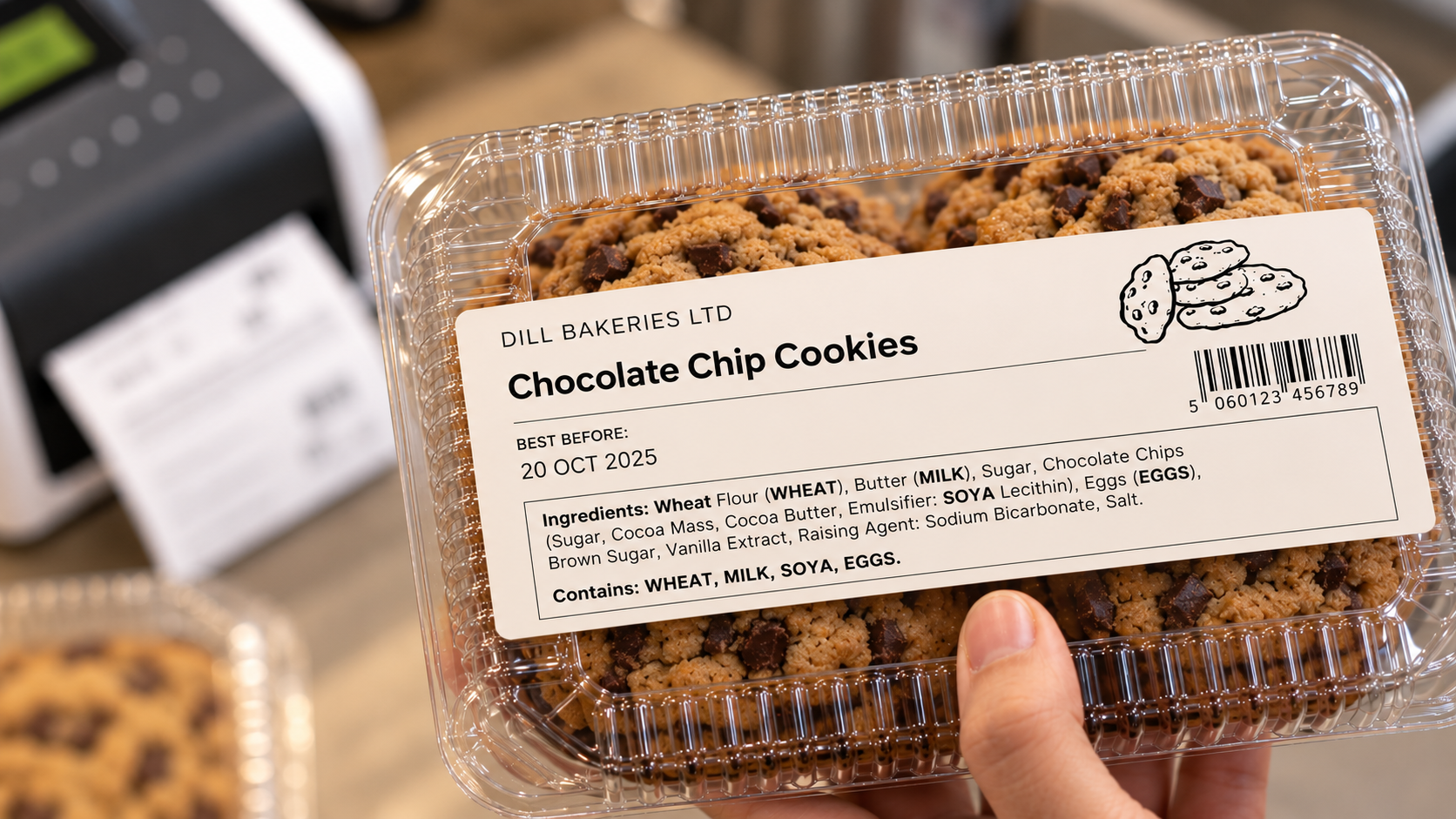
One thing that is clear: unit pricing doesn't change PPDS labels, so your food to go allergen labelling stays as it was.
How Dill handles it
Dill keeps your recipes, ingredients, allergens and shelf lives in one place. It connects to POS/EPOS data, so products aren't retyped, and a change made once reaches every site.
Staff pick the item on a tablet or phone (iOS and Android) and the label prints. Dill prints shelf-edge labels alongside prep and rotation, grab-and-go and made-to-order labels. It runs on Brother label printers, with other hardware on request.
The numbers so far: hundreds of businesses, thousands of sites between them, and over 65 million labels printed. See a retail case study on moving from handwritten to printed shelf-edge tickets, or our guide to choosing food labelling software.
Book a demo to see shelf-edge labels printed from your own product data.
FAQ
When did the Price Marking Order changes start?
06/04/2026, for both amending orders. The 2025 Order moved it from 01/10/2025.
Do small shops need to show unit prices?
Sometimes. Shops of 280 sq m or less are exempt for constant-quantity prepacks and prescribed-quantity bread, but loose goods still need one.
Is per 100 g still allowed?
Per kg or per litre is now required. Nothing we found bans adding per 100 g or permits it, so keep per kg or per litre as the main figure.
Do loyalty prices need their own unit price?
Yes. Article 7A requires each selling price and each unit price, with the conditions displayed prominently close to the product.
Does the Price Marking Order change PPDS labels?
No. The changes affect shelf-edge and price labels, not PPDS allergen labels.
What are the penalties?
Trading standards can prosecute, with an unlimited fine. The CMA can also fine directly, up to £300,000 or 10% of global turnover, whichever is higher.
Does it apply in Northern Ireland?
No. The PMO applies to Great Britain, and Northern Ireland has its own order.