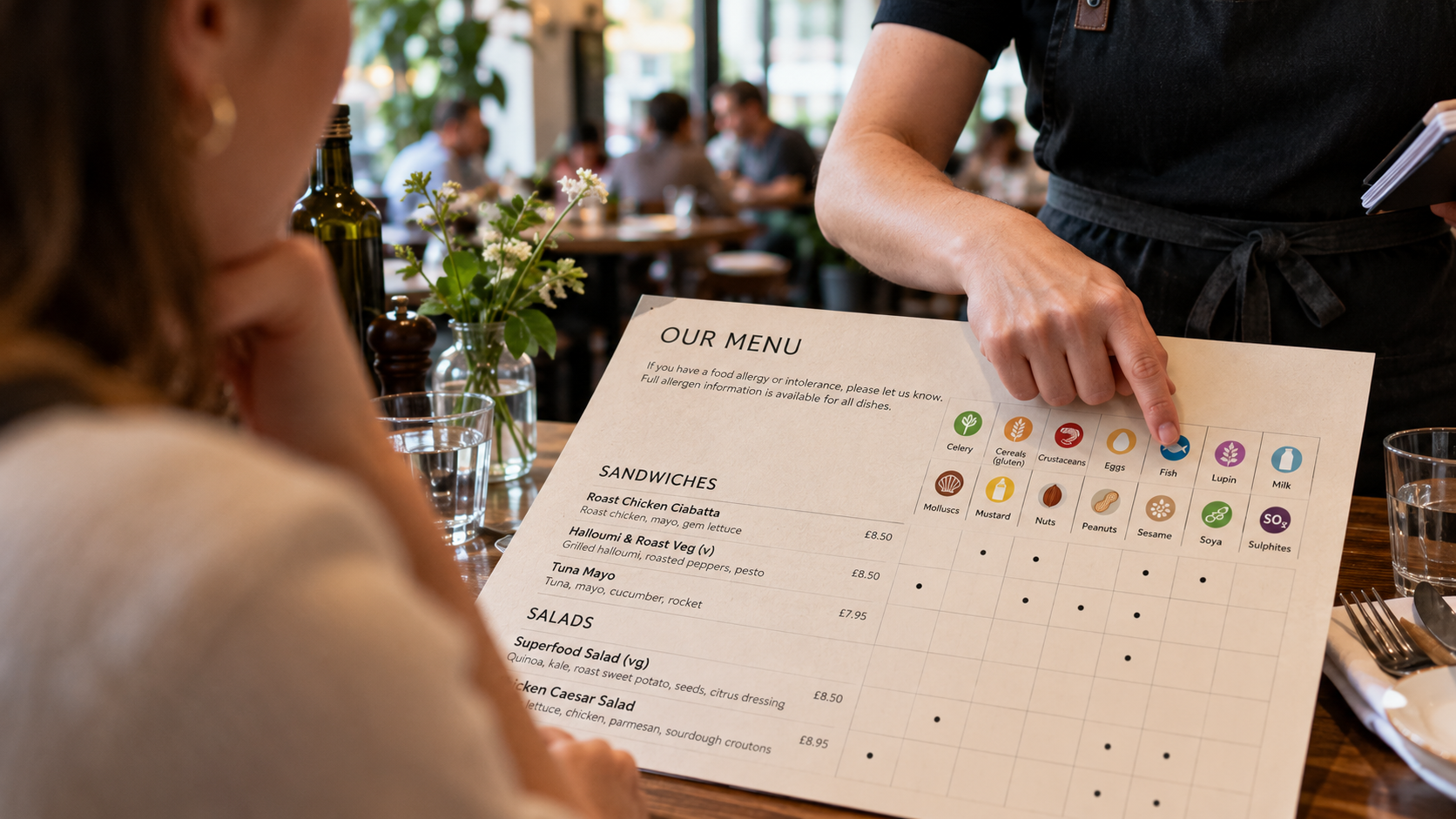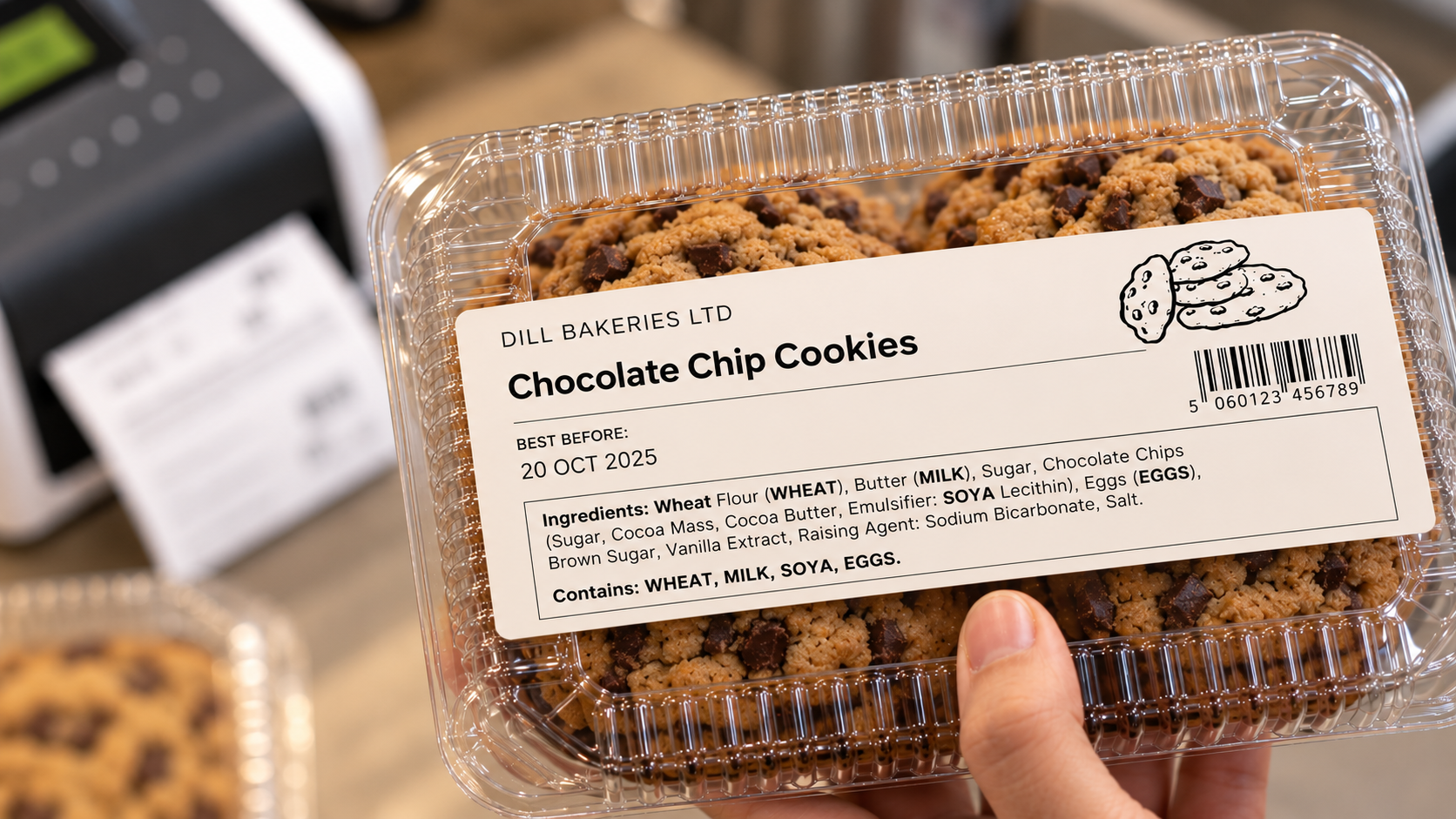
It's 11:40 and lunch starts at noon. Someone on the line holds a chicken Caesar wrap in one hand and a printed spec sheet in the other, running a finger down the label. Is the tortilla broken down? Is the cheese in bold both times? Is that the "Contains" box we were told to remove?
That is food to go allergen labelling on a real shift. For background on what prepacked for direct sale (PPDS) means, read What does PPDS mean?. This post is the label itself, line by line.
Each point is tagged Law (in the legislation), FSA guidance (official guidance, not law in itself) or Good practice (recommended, not required). The rules came into force on 01/10/2021 in England, Wales and Northern Ireland. Scotland requires the same core label under its own rules, with Food Standards Scotland (FSS) guidance.
Natasha's Law label checklist in 60 seconds
- Name of the food, not a brand or fancy name. (Law)
- A heading with the word "Ingredients". (Law)
- Every ingredient, heaviest first, by weight at the time of making. (Law)
- Compound ingredients broken down: bread, wraps, sauces, ham. (Law)
- Additives with their category name, e.g. "Preservative: Calcium Propionate". (Law)
- Added water listed if over 5% of the finished food. (Law)
- Meat percentage for meat products. (Law and FSA guidance, with a grey area)
- Every allergen emphasised, every time. (Law requires emphasis; "every time" is FSA guidance)
- Cereal and nut named: "wheat", not "gluten"; "cashew", not "nuts". (FSA guidance)
- No "Contains:" box repeating the allergens. (FSA guidance)
- x-height of at least 1.2mm, or 0.9mm if the pack's largest surface is under 80cm². (Law)
- On the pack or an attached label, readable without opening. (Law, plus FSA guidance)
- "May contain" only after a risk assessment. (FSA guidance)
- Label updated when a recipe or supplier changes. (FSA guidance)
Line 1: the name of the food
Law. The name must be on the package or a label attached to it. The FSA's PPDS labelling guidance says to use the legal name or, failing that, the customary name, or a descriptive name "precise enough to allow consumers to know the true nature of the product."
FSS is blunt: "Trademarks, brand names or any fancy names cannot be substituted for the name of a food." "The Big Monday" stays on the menu board; the label says "Chicken Caesar Wrap".
Law. The name also includes the physical condition of the food where relevant, and food frozen then sold defrosted is generally labelled "defrosted". There are exceptions, so check.
Line 2: the ingredients list
Heading and order (Law). A heading that includes the word "Ingredients", then every ingredient in descending order of weight at the time of making.
Compound ingredients (Law). If an ingredient is made of ingredients, list them. The FSA's own example: "a sandwich label should include a list of the ingredients in the bread following the name 'bread'." Same for wraps, mayonnaise, pesto, ham and dressings. Your supplier spec is the source. A narrow exemption for some compound ingredients under 2% of the product is too technical to rely on for a sandwich, and allergens must still be declared.
Additives (Law). Category name, then specific name or E number: "Preservative: Calcium Propionate" or "Preservative: E282". FSA guidance says carry-over additives that "serve no technological function in the finished product" need not be listed.
Water (Law). Added water is listed by weight unless it is no more than 5% of the finished food. That exception doesn't cover meat, meat preparations, unprocessed fish or unprocessed bivalve molluscs. Water in bought-in bread or wraps sits inside that ingredient's sub-list, so don't strip it out when copying the spec.
Meat percentage, or QUID (Law and FSA guidance). FSA guidance: "For PPDS foods, QUID is only required for meat products." Write it in brackets after the ingredient, e.g. "pork (80%)", or next to the name, e.g. "containing 80% pork". Chicken counts as meat. See "What's still unclear" below.
Line 3: allergens, emphasised every time
Law. Any of the 14 allergens in the list must be emphasised so it "clearly distinguishes it from the rest of the list of ingredients", for example by font, style or background colour. The 14: cereals containing gluten, crustaceans, eggs, fish, peanuts, soybeans, milk, nuts, celery, mustard, sesame, sulphites (above 10mg/kg or 10mg/litre as SO2), lupin and molluscs.
FSA guidance. The FSA's allergen technical guidance says allergens "must be emphasised every time they appear in the ingredients list." Bold, capitals, contrasting colour or underline are all fine.
Name the cereal (FSA guidance). Wheat, rye, barley or oats, by name. Spelt needs a wheat reference: "spelt (wheat)". You can add "gluten", but the cereal gets the emphasis: "barley (gluten)".
Name the nut (FSA guidance). "The type of nut must be listed and emphasised." Write "cashew nuts", never just "nuts". Pine nuts are not on the legal nut list, so they aren't emphasised.
Milk products (FSA guidance). Emphasising "cheese", "butter", "cream" or "yoghurt" is enough, as they clearly refer to milk.
No "Contains" box (FSA guidance). FSA guidance says that where there is an ingredients list, the rules do not permit voluntary statements like "Contains: wheat, egg and milk" that repeat the allergens. A pointer is fine: "Allergy advice: for allergens, see ingredients in bold."
Size, placement and legibility
Law. Mandatory information must be easy to see, clearly legible and not hidden or interrupted by other text or images. Article 13 sets a minimum x-height (the height of a lower-case "x") of 1.2mm, or 0.9mm where the pack's largest surface is under 80cm², and the PPDS regulation applies it to the ingredients list.
Law. The information goes on the package or a label attached to it, so a printed sticker or printed packaging both work. FSA guidance adds that customers shouldn't need to open the pack to read it, and that handwritten labels are fine if they meet the size rules.
FSA guidance. Update labels when suppliers or ingredients change, and keep reserve pre-printed labels for printer failures.
"May contain": optional, and only after a risk assessment
FSA guidance. Precautionary allergen labelling is not a legal requirement. Use it only if a thorough risk assessment finds a real risk of cross-contact. Otherwise it "could be considered to be misleading food information."
If you use it, name the allergen, ideally the specific food: "not suitable for consumers with nut (hazelnut) allergy." Don't pair it with a "free from" claim for the same allergen. If a supplier's spec carries a "may contain", the FSA says you must pass it on.
What a PPDS label does not legally need (and what's still worth adding)
The PPDS rules list the name, the ingredients list with emphasised allergens, and the meat percentage for meat products. They don't list nutrition, a date mark, net quantity or a business address. FSS states: "There is no legal requirement to apply a durability indication or instructions for use to food sold PPDS." Not required by the PPDS rules isn't the same as never required: other food information rules still apply.
Good practice, kept visually separate from the ingredients:
- A use-by or best-before date, especially for foods like vacuum-packed items.
- A made-on date and the maker's initials, so you can trace a problem to a batch.
- Your business name.
Two example labels
Ingredients are illustrative. Real labels must come from your supplier specs.
Example A: Chicken Caesar Wrap
CHICKEN CAESAR WRAP
Ingredients: Flour Tortilla (Wheat Flour (Wheat Flour, Calcium Carbonate, Iron, Niacin, Thiamin), Water, Rapeseed Oil, Raising Agents: Diphosphates, Sodium Carbonates; Acidity Regulator: Malic Acid; Salt, Preservative: Calcium Propionate), Cooked Chicken Breast (28%) (Chicken Breast, Salt), Romaine Lettuce, Caesar Dressing (Rapeseed Oil, Water, Spirit Vinegar, Egg Yolk, Hard Cheese (Milk), Anchovy (Fish), Garlic, Mustard Seed, Salt, Black Pepper), Hard Cheese (Milk), Croutons (Wheat Flour, Rapeseed Oil, Salt, Yeast).
Allergy advice: for allergens, see ingredients in bold.
Compounds broken down, additives named by category, milk emphasised both times, chicken percentage shown, no "Contains" box.
Example B: Seeded Spelt Loaf
SEEDED SPELT LOAF
Ingredients: Spelt Flour (Wheat), Water, Strong White Wheat Flour (Wheat Flour, Calcium Carbonate, Iron, Niacin, Thiamin), Seed Mix (Sunflower Seeds, Sesame Seeds, Linseed, Pumpkin Seeds), Rye Flour, Salt, Yeast.
Allergy advice: for allergens, see ingredients in bold.
May contain hazelnut.
Spelt references wheat, sesame is emphasised inside a compound, and the "may contain" line names the nut. Include it only if your risk assessment found a real risk.
Wrong vs right: mistakes to fix
1. Sandwich with "gluten" and a Contains box
WRONG: Ham & Cheese Sandwich. Ingredients: Bread, Ham, Cheese, Butter. Contains: Gluten, Milk.
RIGHT: HAM & CHEESE SANDWICH. Ingredients: Malted Bread (Wheat Flour (Wheat Flour, Calcium Carbonate, Iron, Niacin, Thiamin), Water, Malted Barley Flour, Wheat Gluten, Yeast, Salt, Soya Flour, Emulsifier: Mono- and Diglycerides of Fatty Acids; Rapeseed Oil), Ham (20%) (Pork, Water, Salt, Preservative: Sodium Nitrite), Mature Cheddar Cheese (Milk), Butter (Milk).
Bread and ham broken down, cereals named, soya found in the bread, ham percentage shown, Contains box gone.
2. Pesto pot with generic "nuts"
WRONG: Pesto Pasta. Ingredients: Pasta (Durum Wheat), Pesto (Basil, Nuts, Cheese, Oil), Cherry Tomatoes, Parmesan.
RIGHT: PESTO PASTA. Ingredients: Cooked Pasta (Durum Wheat Semolina, Water), Cherry Tomatoes, Pesto (Basil, Sunflower Oil, Cashew Nuts, Hard Cheese (Milk), Pine Nuts, Garlic, Salt, Acidity Regulator: Lactic Acid), Hard Cheese (Milk).
Nut named and emphasised, cheese emphasised every time, order follows weight, pine nuts left plain.
Also watch for: labels not updated after a supplier change, water dropped from sub-lists, small or smudged print, and blanket "may contain" warnings.
Who checks, and what happens if a label is wrong
Local authority food officers enforce the rules. In the FSA and FSS evaluation of PPDS (fieldwork Nov 2022 to Feb 2023), 95% of local authorities had found at least some non-compliance. The most common issues, as shares of local authorities that had encountered them: no labels on PPDS packaging (89%), no ingredients lists (84%) and incomplete ingredients lists (82%).
Law. Failing to give the PPDS allergen information is a criminal offence (in England, under the Food Information Regulations 2014; Wales and Northern Ireland have matching rules), with a fine up to level 5 on the standard scale on summary conviction. In England and Wales that means a fine of any amount, which is why the FSA calls it "a potentially unlimited fine", set by magistrates case by case. Officers can also serve improvement notices.
What's still unclear
- Meat percentage for cafés. The law exempts ready-to-eat food sold by a "mass caterer" from QUID, and allows the figure on a nearby notice or ticket. FSA guidance says QUID is required for PPDS meat products; FSS says it needn't be on the label if available by other means. We haven't found guidance settling whether a typical sandwich shop is a mass caterer. Check with your local authority. Putting the percentage on the label is the safe route.
- Fines outside England and Wales. The "any amount" rule applies to England and Wales only. We haven't verified the maximum in Scotland or Northern Ireland.
How Dill handles it
Dill keeps recipes, ingredients, allergens and shelf lives in one place. Staff pick the item on a tablet or phone, and the label prints with the right allergens, dates and who made it. Change a recipe once and it reaches every site. Dill connects to POS/EPOS data (Clover, Lightspeed, EposNow, CyBake, PosHub), so products aren't retyped, and prints prep and rotation, grab-and-go and made-to-order labels. It runs on Brother label printers, with other hardware on request.
Hundreds of businesses, thousands of sites between them, and over 65 million labels printed. More on our Natasha's Law and PPDS labelling page.
Book a demo before the next lunch rush.
FAQ
What needs to be on a Natasha's Law label?
The name of the food and a full ingredients list with the 14 allergens emphasised every time they appear. Meat products may also need a meat percentage.
Can I put a "Contains" box under the ingredients?
FSA guidance says the rules don't permit a "Contains:" statement repeating allergens when there's an ingredients list. Use "Allergy advice: for allergens, see ingredients in bold" instead.
Should I write "gluten" or "wheat"?
Name and emphasise the cereal: wheat, rye, barley or oats. You can add "gluten" after it.
What font size does a PPDS label need?
An x-height of at least 1.2mm, or 0.9mm if the pack's largest surface is under 80cm². Handwritten labels are fine if they meet this.
Do PPDS labels need a use-by date?
Not under the PPDS rules, and FSS says there's no legal requirement for one on PPDS food. Adding one is good practice, and other food rules may still apply.
Do I need a "may contain" warning?
No. Use it only if a risk assessment finds a real cross-contact risk, and pass on any "may contain" from your supplier's spec.