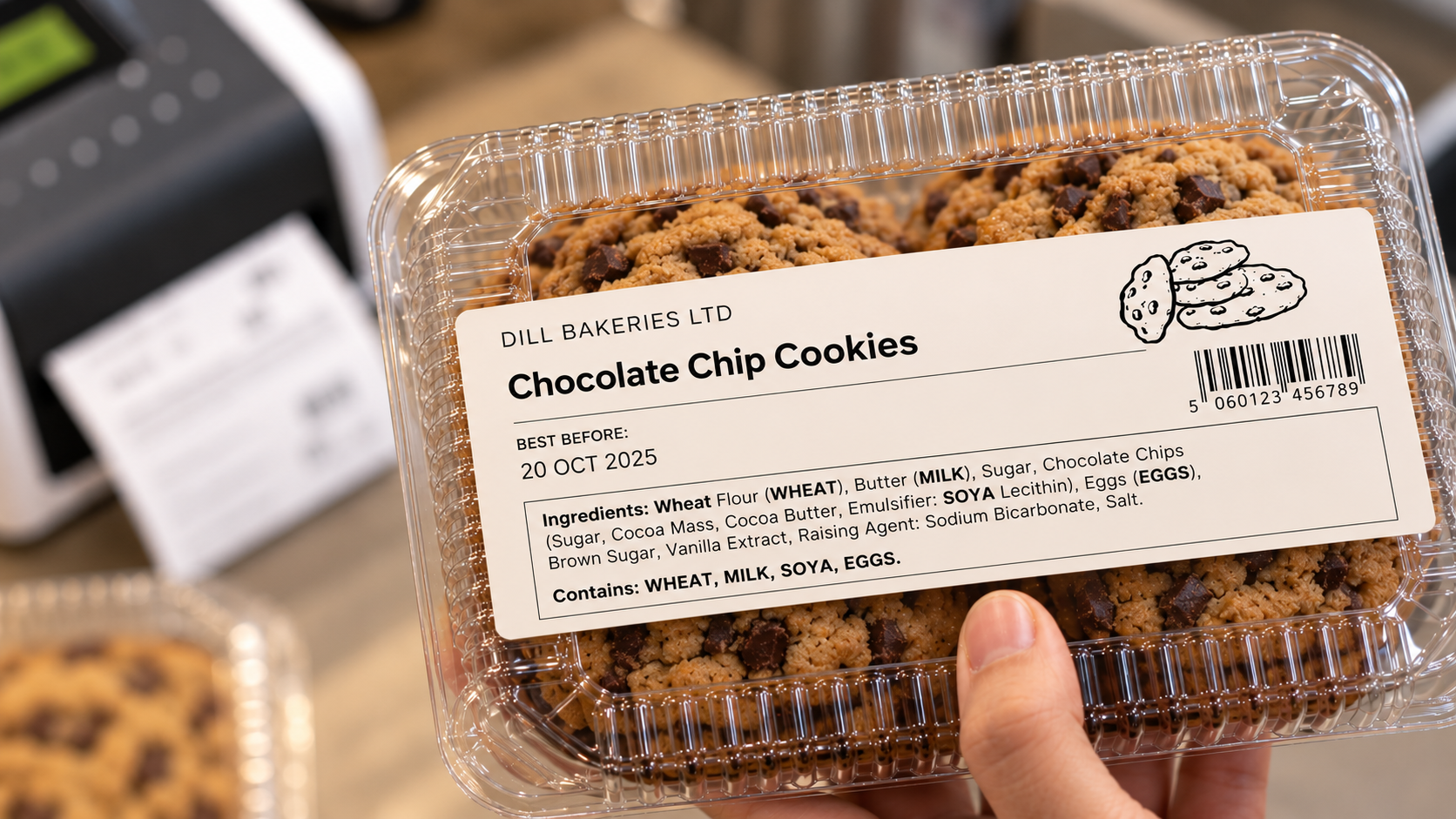
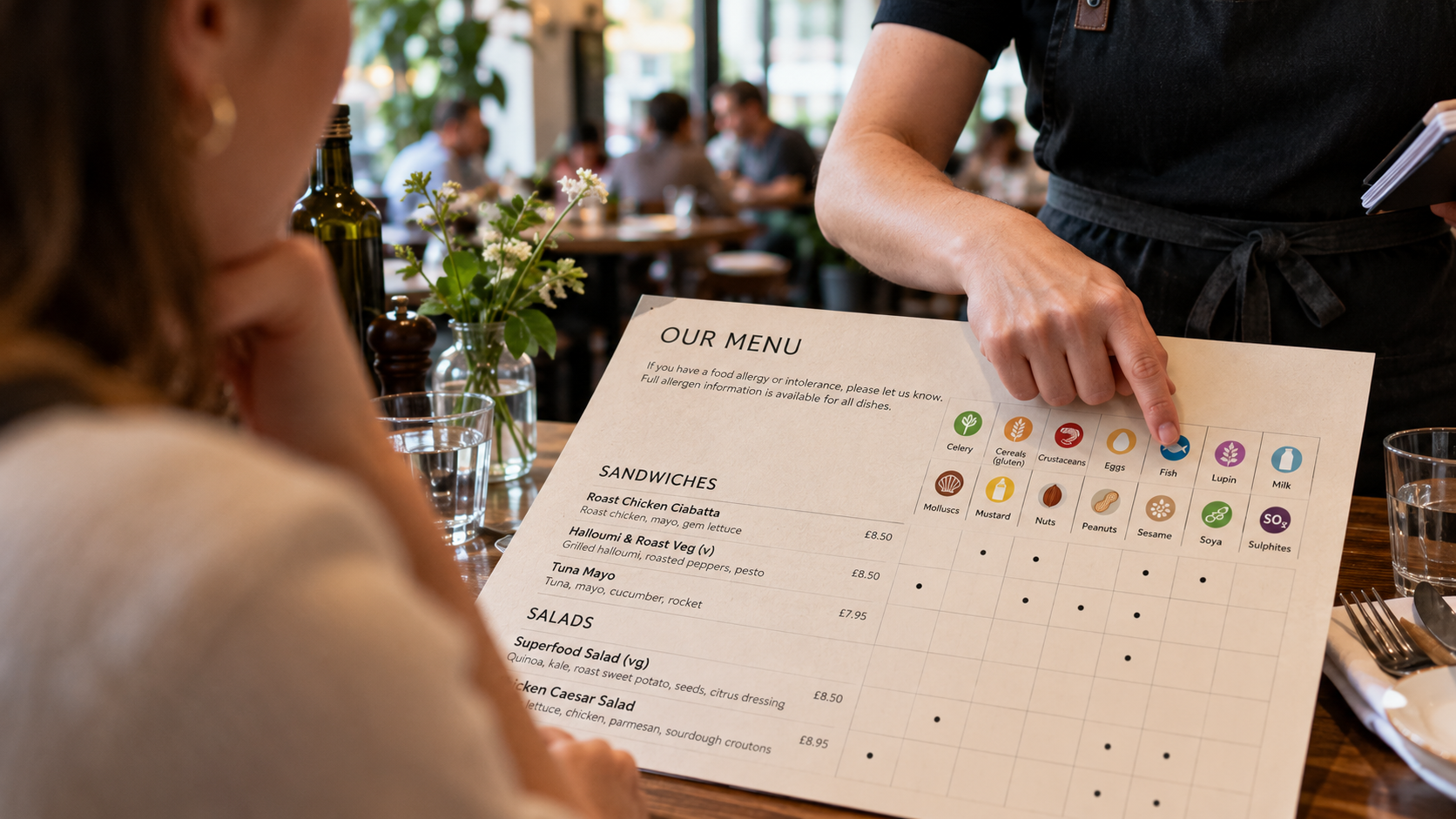
First week of a new term. The office tells the kitchen lead that a new Year 7 pupil has a peanut allergy, and the healthcare plan is on its way. At 10:40 the break queue reaches the grab-and-go fridge: sandwiches, fruit pots, flapjack in clamshells, all packed that morning. Does every item carry the right label? And would the cook on cover know what changed in last week's recipe?
Since 01/09/2026, those questions belong in the allergy safety policy. Benedict's Law refers to section 34 of the Children's Wellbeing and Schools Act 2026. It is named after Benedict Blythe, a pupil who died in 2021 after an allergic reaction at school.
Most of what has been written about it covers adrenaline pens and first aid. This post is about the kitchen.
Benedict's Law in 60 seconds
- Section 34 of the Children's Wellbeing and Schools Act 2026 has been in force in England since 01/09/2026.
- Maintained schools, PRUs and academies must have an allergy safety policy, review it at least once a year and publish it.
- The DfE statutory guidance "Allergy safety in schools" (06/07/2026) expects spare adrenaline pens stored in pairs, and annual allergy awareness training for all pupil-facing staff, including catering staff.
- Compulsory spare pens, rules for independent schools and spare adrenaline nasal sprays are announced or proposed, but not in force yet.
- School caterers are food businesses under the Food Information Regulations 2014. Grab-and-go food packed and sold on site needs a full Natasha's Law (PPDS) label.
- Loose meals need allergen information in writing or from staff, with a written notice if it is given verbally.
What's in force now
Section 34 of the Act inserts section 100A into the Children and Families Act 2014. Every school it covers must have an allergy safety policy, review it at least once a year and publicise it.
It also inserts section 100B, a power to make "allergy safety regulations" later. These could cover keeping medicines and devices, risk procedures, training (caterers are named) and recording incidents. None have been made yet.
Alongside the Act, the DfE published the statutory guidance Allergy safety in schools on 06/07/2026. Governing bodies and proprietors must "have regard to" it, which the guidance defines as taking account of it and carefully considering it. Parts flagged as good practice are non-statutory.
It applies in England to maintained schools (not maintained nursery schools), pupil referral units, and academies including free schools and AP academies (not 16 to 19 academies). Two expectations matter most here:
- Spare adrenaline pens. "We expect that all schools will stock 'spare' adrenaline devices", and they "should always be stocked and stored in pairs." Schools in England have been allowed to buy spare auto-injectors without a prescription since 01/10/2017.
- Training. All staff present when pupils are on site should have annual allergy awareness training. This "includes catering staff" and breakfast and after school club staff. "First aid training is not sufficient."
According to the DfE guidance, around one in five children and young people with allergy have their first allergic reaction while in school, college or early years settings.
What's announced but not in force yet
- A legal duty to stock spare adrenaline. The government intends to bring this in through future regulations. We found no date yet.
- Independent schools and non-maintained special schools. The guidance is not yet statutory for them. The government intends to introduce equivalent requirements through their regulatory standards.
- Spare adrenaline nasal sprays. The MHRA is consulting on letting schools hold them. The consultation closes on 14/12/2026.
Who owns what: leaders and the kitchen
The guidance is direct: "Responsibility for allergy safety should not be left with a catering manager." Governors or the proprietor own the policy, with a named senior lead.
The policy still depends on the kitchen getting the food information right. The guidance also says catering staff should be available to meet parents and carers to discuss allergen safe meals. So the kitchen lead belongs in the room when the policy is written.
With a contract caterer, the caterer is the food business and holds the recipe and supplier data, while the school owns the policy. Write down who tells whom when a recipe changes, when a pupil with an allergy joins, and when something goes wrong.
Grab-and-go: Natasha's Law (PPDS) labels
The DfE guidance says the Food Information Regulations 2014 "require all food businesses, including school and college caterers," to provide information on the 14 regulated allergens. That applies whether the kitchen is run in-house or by a contractor. What the law asks for depends on how the food is sold.
PPDS means prepacked for direct sale. The FSA's PPDS guidance for schools, colleges and nurseries defines it as "food that is packaged at the same place it is offered or sold to consumers." Its school examples include fruit pots, breakfast pots and "packaged sandwiches or salad boxes." That is most of a break time fridge.
Every PPDS label needs the name of the food and a full ingredients list with the 14 allergens emphasised. Compound ingredients must be broken down, so if the bread contains soya flour, the label says so. This is food to go allergen labelling, and the rules match the high street. Our Natasha's Law PPDS guide has the full detail.
Two edge cases:
- Food packed by another business off-site is "prepacked" food and should arrive with the supplier's full label.
- Where parents pay in advance without ordering specific items, food "could be considered PPDS depending on if and how it is packaged."
A worked example. The ingredients are illustrative only; real labels must come from your own recipes and supplier specifications.
Cheese and pickle sandwich on wholemeal bread
Ingredients: Wholemeal bread (wholemeal wheat flour, water, yeast, salt, rapeseed oil, soya flour, preservative: calcium propionate, flour treatment agent: ascorbic acid), mature Cheddar cheese (milk), pickle (sugar, carrot, swede, onion, cauliflower, gherkin, spirit vinegar, barley malt vinegar, water, tomato paste, salt, modified maize starch, colour: caramel E150c), butter (milk).
Allergens in bold.
Use by: 03/11/2026. Keep refrigerated below 5°C. (optional)
Made in the school kitchen. (optional)
Barley malt vinegar is easy to miss: barley is a cereal containing gluten, so it must be emphasised. The use-by and storage lines are good food safety practice, not PPDS requirements. Nor are "may contain" statements, nutrition or ingredient percentages.
If a central kitchen packs the sandwich and delivers it to another school, it may count as "prepacked" rather than PPDS, depending on the operator and premises. Check the FSA guidance.
Loose school meals: allergen information without a label
A hot lunch served onto a plate is loose food. The FSA says "Non-prepacked (loose) food does not require a label." Allergen information is still required.
In England, regulation 5 of the Food Information Regulations 2014 lets you give it any way you choose, including verbally. If you rely on staff, you must say so in writing "on a notice, menu, ticket or label that is readily discernible by an intending purchaser." The FSA adds that symbols on menus should come with words.
Name the allergen properly: "cereals containing gluten (wheat)" rather than just "gluten". Our page on Owen's Law and allergens on menus covers menu wording in more depth.
A worked example for a menu card. The recipe is illustrative: durum wheat pasta (egg-free), chicken, mixed vegetables, white sauce made with milk, butter and wheat flour, Cheddar, and vegetable stock containing celery.
Tuesday: Chicken and vegetable pasta bake
Contains: cereals containing gluten (wheat), milk, celery.
Allergen information is checked against today's recipe and product labels. If your child has a food allergy, the kitchen team will confirm today's ingredients before serving. Please speak to a member of catering staff.
The allergen matrix for that day should match line for line: wheat from the pasta and sauce, milk from the sauce and cheese, celery from the stock, no egg or mustard.
The DfE guidance adds pupil-level controls: individual healthcare plans, and "Children and young people with food allergies should not be segregated from their peers at mealtimes."
Recipe changes and supplier swaps
This is where things usually go wrong. The menu card was right in September. Then the stock changed brand, or the bread supplier sent a different loaf.
The DfE allergy guide for school food tells schools substituting menu items: "you must make sure you can continue to meet any special dietary needs." It also says to "ask your caterers to read labels and product information before using a product."
Every ingredient change should reach three places the same day: the recipe, the PPDS labels and the menu card or matrix. Update any of them by hand from memory and they drift apart.
The guidance also says schools operating as food businesses "should record and review all allergen incidents." Smaller in-house operators can ask their local environmental health team for advice.
Kitchen checklist for the allergy safety policy
- Name the senior lead who owns the policy and the kitchen lead who feeds into it.
- List every item packed on site: sandwiches, wraps, salad boxes, fruit pots, breakfast pots, packaged bakes.
- Check each PPDS label has the food name and a full ingredients list with allergens emphasised and compound ingredients broken down.
- Check bought-in prepacked items arrive with the supplier label intact.
- For loose meals, choose how allergen information is given. If verbally, put up a written notice saying so.
- No new product goes into a dish until the recipe, label and menu information are updated.
- Agree how the kitchen hears about new pupils with allergies and their healthcare plans.
- Book annual allergy awareness training for all catering, breakfast and after school club staff.
- Log allergen incidents and near misses, and review them.
- With a contract caterer, write down who does each of the above.
The DfE publishes an allergy safety policy template on the guidance page, which is a good starting point.
What's still unclear
- Timing of compulsory spare adrenaline. We found no timetable for the regulations.
- Catering-specific duties. Section 100B could set rules on training and procedures affecting caterers. Nothing has been made yet.
- Wales, Scotland and Northern Ireland. Section 34 extends to England and Wales, but the commencement rules describe duties on schools in England, and we could not verify equivalents elsewhere. Treat the guidance as England only. PPDS rules do apply UK-wide.
- Medical conditions guidance. The DfE consulted in 2026 on replacing "Supporting pupils with medical conditions". We could not confirm whether it has been finalised.
How Dill handles it
Dill keeps recipes, ingredients, allergens and shelf lives in one place. Recipes are built from ingredients, so when the stock or the bread changes, you update the ingredient once and every recipe that uses it updates too.
Staff pick the item on a tablet or phone (iOS and Android) and the label prints with the right allergens, dates and who made it. Dill prints grab-and-go, prep and rotation, made-to-order and shelf-edge labels. Running several school kitchens? A change made once reaches every site. See centralised labelling for schools.
Dill runs on Brother label printers, with other hardware on request. The numbers so far: hundreds of businesses, thousands of sites between them, and over 65 million labels printed.
Book a demo to see it set up for a school kitchen.
FAQ
Is Benedict's Law in force?
Yes. Benedict's Law refers to section 34 of the Children's Wellbeing and Schools Act 2026, in force in England since 01/09/2026. It requires schools to have, review annually and publish an allergy safety policy.
Must schools have spare adrenaline pens?
Not by law yet. The DfE statutory guidance expects schools to stock spare adrenaline pens in pairs, and the government intends to make this a legal duty through future regulations.
Does Benedict's Law apply to independent schools?
Not yet. The government intends to bring in equivalent requirements for independent and non-maintained special schools through their regulatory standards.
Do school dinners need allergen labels?
Loose meals do not need a label, but allergen information must be available in writing or from staff. If it is given verbally, a written notice must tell people to ask.
Do grab-and-go sandwiches made in the school kitchen need Natasha's Law labels?
Yes. Food packed where it is sold is PPDS, so it needs the food name and a full ingredients list with allergens emphasised.
Do catering staff need allergy training?
Yes. The guidance expects annual allergy awareness training for all staff on site when pupils are, including catering staff. First aid training alone is not enough.
Who is responsible for allergy safety, the school or the caterer?
School leadership owns the policy, and the guidance says it should not be left with a catering manager. The caterer is responsible for accurate allergen information on the food it serves.