A product is set up correctly. The recipe is loaded, the ingredients are listed, the fourteen regulated allergens are emphasised inside the list. Someone signs it off. It prints. It is correct.
Then a supplier changes the base on a sauce. A chef at head office swaps an ingredient to improve a margin. A site runs out of one bread on a Friday and finishes the shift with another. None of those three people did anything obviously wrong, and none of them touched a label.
Six weeks later the label on the shelf and the food inside the pack are two different things.
This is the part that does not get written about. Almost nobody in UK food to go gets caught out by not knowing the rule any more. Natasha's Law has been in force since 1 October 2021, so on 1 October 2026 it will have been five years. The rule is settled. What is not settled is how an operator keeps a label matching the food for five years while the menu, the suppliers and the sites underneath it keep moving.
That problem is drift. Here is what it actually looks like.
1. The label says the recipe. The kitchen made something else.
The most common failure, and the least dramatic. A site runs out of something and substitutes. Sourdough instead of the usual bloomer. A different brand of mayonnaise because the delivery was short. In a kitchen that is usually the right call, and service continues.
The label does not know. It is printing from a product record that was set up weeks ago, and there is no route from a decision made at 07:40 on a Saturday back to the thing coming out of the printer.
This is where the real exposure sits, because the food and the label disagree while everything looks normal. Nobody is going to spot it on a shelf. The gap only becomes visible when a customer with an allergy asks, or reacts.
No system stops a site substituting an ingredient. What a system can do is make the substitution cheap to reflect. If the product record is central and the printer pulls from it, changing the record changes every label from the next print onwards. If the record lives in a spreadsheet that someone emails out, the substitution never makes it back.
2. The allergen is in the "Contains" line but not inside the ingredient list.
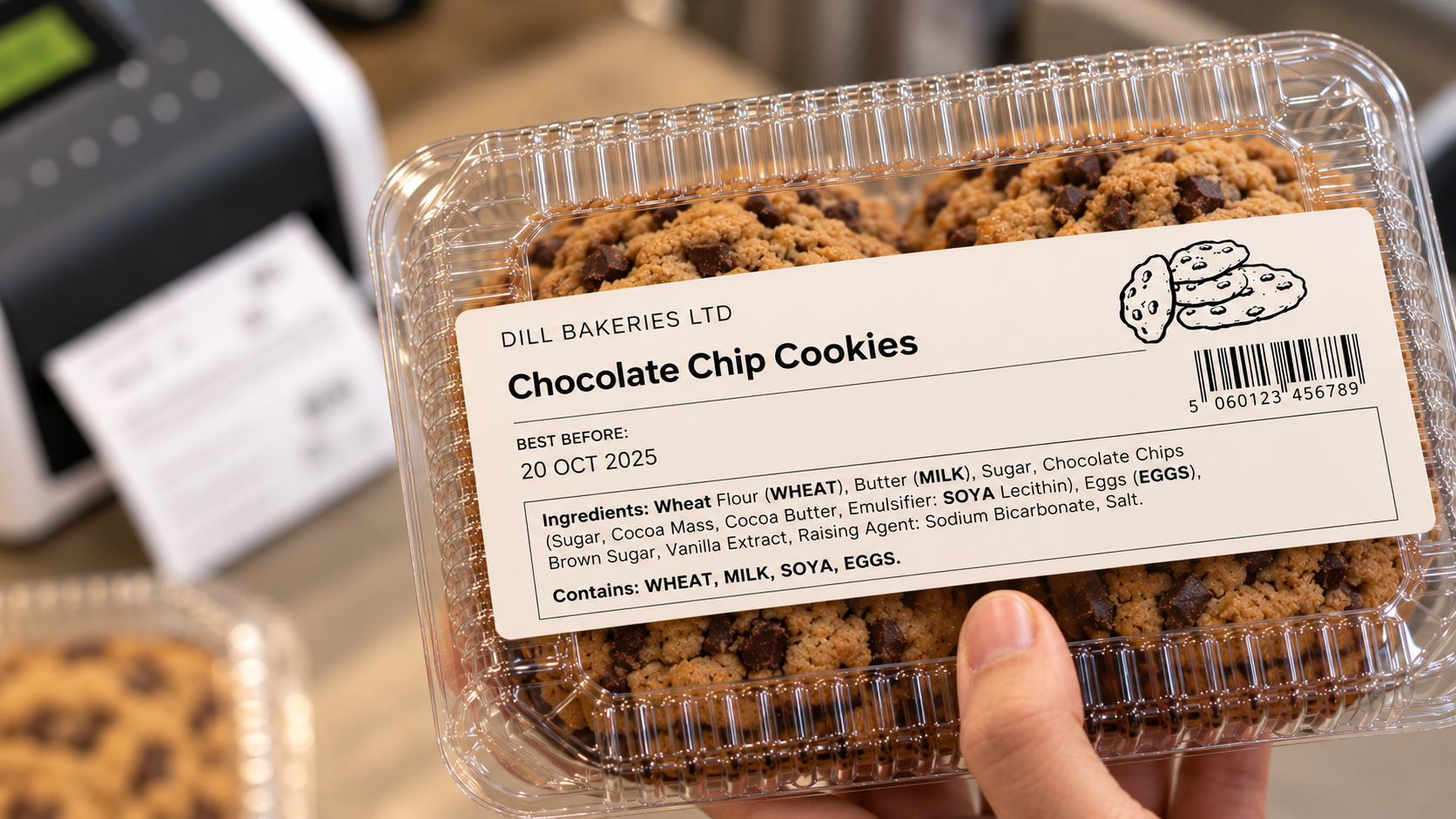
This one fails the legal test outright, and it is common because it looks careful. A label carries a full ingredient list and then, underneath, a helpful summary: Contains: milk, wheat. Inside the list itself, nothing is emphasised.
That is not what the law asks for. The requirement is that the fourteen regulated allergens are emphasised within the ingredient list, using bold, capitals, contrasting colour or underlining. GOV.UK guidance puts it plainly, and adds a detail that catches people out: the allergenic ingredients "must be emphasised every time they appear in the ingredients list". Not the first mention. Every mention.
A separate "Contains" statement has a proper job, but a different one. It is what you use where no ingredient list is required at all. It is an addition, not a substitute. A label with a perfect Contains line and an unemphasised list is a non-compliant label.
3. The ingredient list stops at the component name.
A sandwich label reads: Bread, Chicken, Mayonnaise, Lettuce.
Mayonnaise is not an ingredient. It is a compound ingredient, and it has its own ingredients, including egg. Egg is one of the fourteen. As written, that label does not declare it.
The rule allows two ways to handle this, and both are fine. You can break the constituent ingredients out and list them as ingredients of the whole product, or you can list them immediately after the compound ingredient in brackets: Mayonnaise (rapeseed oil, egg yolk, vinegar, mustard). What you cannot do is stop at the name.
This is where most of the quiet inaccuracy in UK food to go lives, and it is rarely deliberate. It happens because whoever set the product up entered what they buy rather than what is in what they buy, and nothing downstream checked. Marinades, dressings, stocks, glazes, coatings, spice blends and bought-in sauces are the usual offenders.
4. The same product has three different labels because it has three different sites.
Multi-site operators know this one. Same product name on the menu, three sites, three labels that do not match. Different wording, different emphasis, sometimes a different allergen set.
Nobody chose that. It happened because each site printed from a template that was current on the day it was set up, and the sites were set up at different times. There is no single version of the product, so there is no single version of the label.
The tell is easy to check and worth checking this week: print the same product at three sites and put the labels next to each other. If they differ, you do not have a labelling problem. You have a data problem that is showing up on labels.
5. The handwritten fallback.
The printer jams. The roll runs out. The tablet will not connect. Service is at its peak and product is going out, so someone writes the label by hand.
Handwritten labels are legal. GOV.UK guidance is explicit that food labels can be handwritten as long as they meet the legal font size requirements and are easily visible and clearly legible. This is not a rule problem, it is a control problem.
A handwritten label is written from memory, at speed, by whoever is nearest. It is not checked against the product record because in that moment there is nothing to check against. Compound ingredients get flattened to their component names. Emphasis gets forgotten. The full list becomes a short list.
Handwritten fallback is where the worst individual errors happen, and it is also the least measured, because a handwritten label leaves no record that it existed. If you want one number to go and find, it is this one: how many times last month did a site fall back to handwriting, and does anyone know?
What these five have in common
Two of them (numbers 2 and 3) are genuine knowledge gaps about what a correct label looks like, and they are fixable with a template built right once.
The other three are not labelling problems at all. Substitution, version drift and handwritten fallback are the same underlying condition: the allergen data lives somewhere disconnected from the thing that prints. A spreadsheet, a recipe folder, a supplier spec pack, someone's memory at 07:40 on a Saturday. When those two things are separate, drift is not a risk. It is a certainty, and the only variable is how long it takes.
So the useful question is not "are our labels correct". It is two other questions:
When a recipe or an ingredient changes, how long until every site is printing the new label? If the honest answer is anything other than "the next time it prints", you have a window. Everything printed inside that window is wrong.
Who can change the label itself, and what do they have to do to change it? This is the one operators underrate. If adding a field, changing a pack size layout or fixing emphasis means raising a support ticket with a supplier and waiting, then labels do not get fixed when they are noticed. They get fixed at the next convenient moment, or added to a list. The cost of a change determines how often changes actually happen.
That second question is the one we built around. In Dill, a recipe or ingredient change is made in one place and every site prints the updated label from the next print onwards, so the window closes at the next print rather than at the next menu cycle. And label layouts are edited in the label designer inside the app by the operator, not through a change request to us.
[CONFIRM before publication: self-serve label designer, exact scope of what an operator can change without Dill involvement. Also confirm "from the next print onwards" holds in every case, or state the caveat. Delete this block before publishing.]
To be clear about what that does and does not mean. No software makes an operator compliant. The legal responsibility for a correct label sits with the food business, and it always will. What a connected system changes is the mechanics: how fast a correction travels, how many places a fact has to be entered, and how much friction sits between noticing a problem and fixing it. Those are the variables that decide whether a label is still right in month eighteen.
The same argument applies to centralised stock rotation labelling and to prep labelling. It is one system because it is one set of data. Dill sits on top of the POS and ERP systems an operator already runs, including Lightspeed, Clover, CyBake, EposNow and PosHub by FoodHub for Business, rather than replacing them, and it runs on Brother hardware.
If you want the requirement itself rather than the operational side of it, what Natasha's Law actually requires on a PPDS label covers the scope test, the fourteen allergens, the emphasis rules and the things people wrongly believe are required.
Bring a label you are unsure about
Dill is exhibiting at Hospitality Tech Expo 2026 at ExCeL London on 29 and 30 September, on stand HT416. Show hours are 10:00 to 16:00 both days and registration is free. The nearest entrance is the West Entrance, from Custom House on the Elizabeth line and DLR. The show is co-located with the Hotel & Resort Innovation Expo.
Everything described above will be running live on the stand on Brother hardware. A senior end user specialist from Brother UK will be there alongside the Dill team, so hardware questions get answered on the day rather than followed up later. Dill is a Brother UK Gold Partner.
The useful thing to do with a stand is not to watch a demo. Bring a label you are not sure about, or a menu item that is difficult to label properly (the ones with a bought-in sauce are usually the interesting ones), and we will build it in front of you and tell you honestly whether the problem is the label or the data behind it.
Dill is used in the UK by BrewDog, Jamie Oliver, atis, Busaba and more, and across convenience and food to go operations trading under Co-op, Budgens and Nisa Local fascias on service station forecourts. At Le Cafe by Nicolas Rouzaud in Burlington Arcade, labels are produced from the system for any product set up in it, with products added progressively.
Hospitality Tech Expo 2026. 29 and 30 September. ExCeL London. Stand HT416.
Frequently asked questions
Is a "Contains: milk, wheat" line on its own enough to meet Natasha's Law?
No. Where the food requires an ingredient list, the fourteen regulated allergens must be emphasised inside that list, using bold, capitals, contrasting colour or underlining. GOV.UK guidance states that allergens must be emphasised every time they appear in the list, not only on first mention. A separate "Contains" statement is used where no ingredient list is required. It is an addition to a compliant label, not a replacement for emphasis within the list.
Do I have to list the ingredients of a compound ingredient like mayonnaise or a bought-in sauce?
Yes. Stopping at the component name is not sufficient, because the allergens inside it are not declared. Food Standards Scotland guidance sets out two acceptable methods: list each constituent ingredient as an ingredient of the whole product, or list the constituent ingredients immediately after the compound ingredient, for example "Mayonnaise (rapeseed oil, egg yolk, vinegar, mustard)". Either is fine. Neither is optional.
Is there an exemption for small businesses?
No. There is no small business exemption from the PPDS requirements. The duty applies to a single site the same way it applies to a national estate.
Does a PPDS label need a use-by date, nutrition information or storage instructions?
Not under the PPDS requirements. The PPDS duty is the name of the food plus a full ingredient list with the fourteen regulated allergens emphasised within it. Use-by dates, nutrition information, storage instructions, a business address and net quantity are not required by these rules. Some of them may be required by other legislation or sensible for food safety reasons, so do not remove anything without checking why it is there.
Are handwritten PPDS labels allowed?
Yes. GOV.UK guidance confirms that food labels can be handwritten provided they meet the legal font size requirements and are easily visible and clearly legible. The practical risk is not legality, it is accuracy: a handwritten label is usually produced under time pressure without reference to the product record, which is where compound ingredients get flattened and emphasis gets dropped.
What happens if a PPDS label is wrong?
Enforcement sits with local authorities. On summary conviction the penalty is a level 5 fine. There is no custodial penalty attached to these particular requirements. In practice most enforcement begins with advice and improvement rather than prosecution, but the legal responsibility for the accuracy of the label sits with the food business operator.
Do these rules apply to food I sell online for delivery?
The on-pack ingredients duty does not apply in the same way to distance selling, which is exempt from that requirement. Allergen information still has to be provided to the customer through other means at the right points in the ordering process, so this is an exemption from the on-pack duty rather than from providing allergen information at all. Check the current FSA guidance for distance selling before changing anything.
Sources
- Food Information (Amendment) (England) Regulations 2019, SI 2019/1218
- Food Information (Wales) (Amendment) (No. 2) Regulations 2019, WSI 2020/295
- Food Information (Amendment) Regulations (Northern Ireland) 2020, SR 2020/80
- Food Information (Scotland) Amendment Regulations 2021, SSI 2021/70
- Labelling guidance for prepacked for direct sale (PPDS) food products, GOV.UK
- Introduction to allergen labelling for PPDS food, GOV.UK
- Allergen labelling changes for prepacked for direct sale (PPDS) food, Food Standards Agency
- Labelling of Food Sold Prepacked for Direct Sale, Food Standards Scotland, May 2023 (compound ingredients p7, emphasis p8)
- Allergen guidance for food businesses, Food Standards Agency