A customer asks the server, "Is there any dairy in this?" Today, a spoken answer is legal, as long as a sign tells customers they can ask staff. The Owen's Law campaign wants that information written down, on the menu, before anyone has to ask.
Owen's Law isn't in force yet, but the direction is clear. Here's what the rules ask of you today, what the FSA recommends, and what's changing, as of 12/10/2026.
Owen's Law in 60 seconds
- Owen's Law isn't in force yet. It's a proposal to make written allergen information on menus a legal requirement. No bill has been introduced in any UK nation so far.
- The law for non-prepacked food is unchanged. You must make the 14 allergens available, but you can do it "by any means", including verbally, as long as a sign, menu or ticket tells customers to ask staff.
- FSA best practice guidance (early 2025) recommends written allergen information, ideally without the customer having to ask, plus asking every customer about allergies. It applies in England, Wales and Northern Ireland, and it is not legally binding.
- The FSA supports it. Its Board backed mandatory written information on 13/12/2023. A change in the law is a decision for Ministers, and no timetable has been set yet.
- Scotland is consulting separately. Food Standards Scotland ran a consultation from February to May 2026. No outcome has been published.
- PPDS food is different. Food packed on site before it's ordered has needed a full ingredients label since 01/10/2021.
What the Owen's Law campaign asks for
The campaign is named after Owen Carey, who died in 2017 after an allergic reaction to a restaurant meal. It wants allergen information in restaurants to be clearer and written down.
It asks for restaurants to:
- List the 14 allergens "in writing at the point of ordering", "without the customer having to ask"
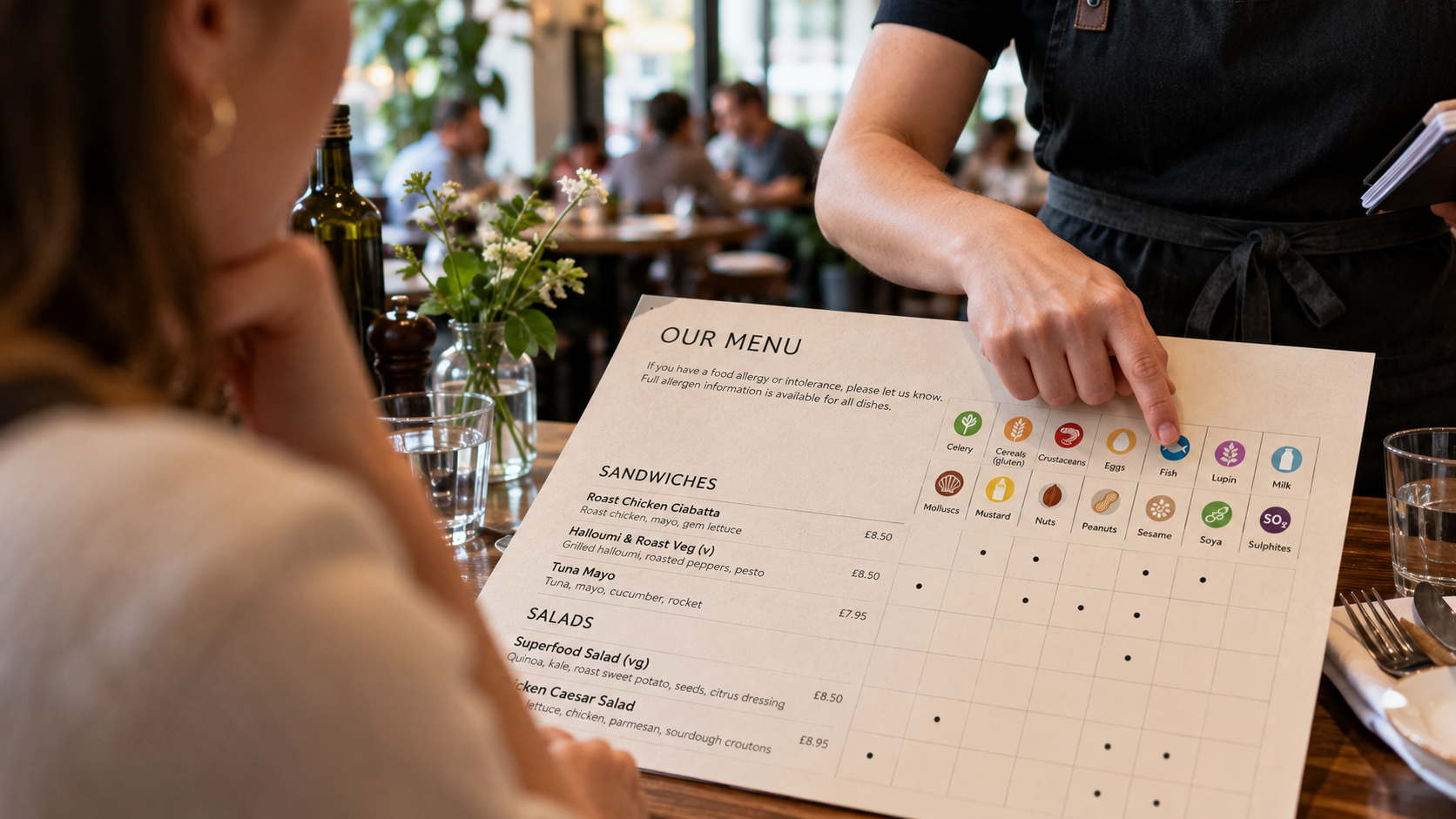
- Provide an allergen matrix for each dish
- Have servers ask every customer about allergies
- Make non-compliance an offence
In April 2021 the campaign wrote to Defra asking for changes to Regulation 5 of the Food Information Regulations 2014, the rule that currently allows allergen information to be given verbally. None of these is a legal requirement yet, but the FSA has backed the main one.
What the law requires today for non-prepacked food
"Non-prepacked" covers most café and restaurant food: plated meals, loose counter food, dishes made to order.
The starting point is assimilated EU law, Regulation 1169/2011, Article 44: allergen information for non-prepacked food is mandatory, and each nation decides how it is made available.
In England, that's regulation 5 of the Food Information Regulations 2014. It says:
- You can give the allergen information "by any means the operator chooses", which includes orally.
- If you give it orally, you must make clear that the details "can be obtained by asking a member of staff".
- That signpost must be on a label attached to the food, or "on a notice, menu, ticket or label that is readily discernible by an intending purchaser".
In plain terms: a written allergen menu is not legally required. A clear written signpost to ask staff, plus staff who answer accurately, meets the legal minimum.
Wales and Northern Ireland have their own 2014 regulations with the same "by any means the operator chooses" wording.
Scotland's 2014 regulations word it slightly differently, "in any manner that they choose, including... orally", with the same "asking a member of staff" and "notice, menu, ticket or label" requirements. The effect is the same across all four nations.
What the FSA's best practice guidance recommends
In early 2025 the Food Standards Agency published Allergen information for non-prepacked foods: best practice. It applies in England, Wales and Northern Ireland, not Scotland.
The guidance itself says: "You are not required by law to follow best practice guidance." It also says: "The minimum legislative requirement for information to be provided by any means (with a sign indicating when it will be provided verbally) has not changed."
What it recommends is written information plus a conversation:
- Written, without having to ask. Allergen information "should be readily available, if possible, without consumers having to ask for it, such as on the main menu (paper or digital), allergen booklet on a counter or matrix displayed on a wall in a consumer accessible area".
- Name the allergen. Symbols are fine, but "If symbols are used, the name of the allergen should form part of it."
- An allergen matrix. The guidance includes an example matrix showing which allergens are in which dish.
- Ask every customer. "Food businesses should ask all consumers whether they have any allergen requirements to encourage these discussions." Where staff can't ask everyone, it suggests a sign: "Please talk to us if you have a food allergy, intolerance or coeliac disease. We want to cater safely for everyone."
- No menu? Use the board. Businesses without a menu "should display this message where they display their food options such as on a board or next to food in a counter."
- Consistent recipes. Keep a record of recipes so dishes are made the same way each time, and minimise last-minute substitutions. If one happens, "ingredients should be checked and allergen information updated accordingly."
- Trained staff who can hold a proper conversation about allergens.
For delivery and online ordering, the law (Article 14 of Regulation 1169/2011) already says allergen information must be available before purchase and at delivery. The guidance adds that it should be written at both points. More in our guide to allergen labelling for delivery orders in the UK.
Where things stand in October 2026
What has actually happened so far:
- 13/12/2023: The FSA Board agreed written allergen information for non-prepacked food should be a legal requirement.
- By the end of January 2024: The FSA Chair had written to Defra asking for exactly that.
- Early 2025: The FSA published best practice guidance. It has said it does "not have the power to decide whether legislation should be introduced". That is for Ministers.
- 26/06/2025: In the House of Lords, a Defra minister said evaluation of the guidance was "likely to begin in spring 2026", to inform Ministers on "the need for any potential legislation".
- 16/09/2026: The FSA's annual science update to its Board said it is evaluating the guidance and that "Findings will inform the development and design of future legislation."
The government hasn't set a timetable yet, so no one can say for sure when a change will come.
Scotland is on its own track. Food Standards Scotland ran a 12-week consultation on written allergen and ingredient information from 23/02/2026 to 17/05/2026. It looked at possible changes to guidance, including information beyond the 14 allergens. No outcome had been published by 12/10/2026.
How this differs from PPDS and delivery
- Non-prepacked (plated, loose, made to order): verbal is legal with a written signpost. Written is best practice.
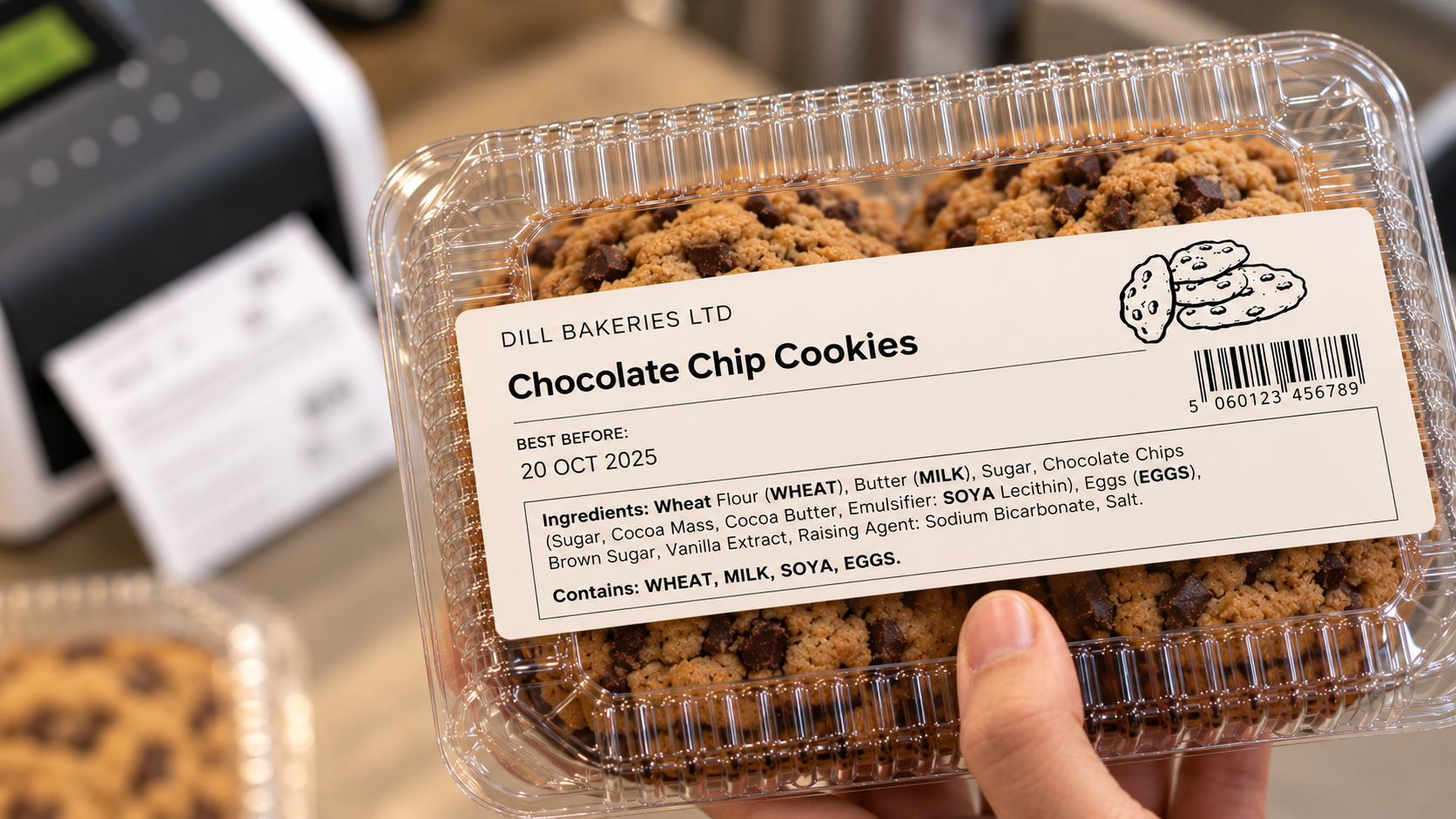
- Prepacked for direct sale (PPDS): food packed on site before it's ordered, like a sandwich wrapped in the morning. Since 01/10/2021 it has needed a label with the food's name and a full ingredients list, allergens emphasised. That is law. See what PPDS means. Made-to-order hot drinks and an open carton of chips are not PPDS.
- Distance selling (delivery, online): allergen info must be available before purchase and at delivery. PPDS rules don't apply.
Worked examples
All ingredients below are illustrative. Check your own recipes and supplier specs.
A main menu line (best practice: written, allergens named, not symbols alone):
Halloumi wrap: grilled halloumi, flour tortilla, houmous, salad, chilli sauce
Contains: milk, cereals containing gluten (wheat), sesame
Please talk to us if you have a food allergy, intolerance or coeliac disease. We want to cater safely for everyone.
A specials board line (no printed menu, so the board does the work):
Today's soup: roasted tomato and basil, served with sourdough
Soup contains: celery. Bread contains: cereals containing gluten (wheat)
Ask us about allergens before you order
If the soup recipe or bread supplier changes, update the board and the allergen matrix the same day.
For contrast, a PPDS label (a sandwich made up in advance and wrapped on site, where a full label is the law):
Egg Mayo Sandwich
Ingredients: Bread (wheat flour (wheat flour, calcium carbonate, iron, niacin, thiamin), water, yeast, salt), boiled egg, mayonnaise (rapeseed oil, water, egg yolk, spirit vinegar, salt, mustard seed), cress
Allergens in bold. Made on site: 12/10/2026. Use by: 13/10/2026
Dates and who made it are good practice, not part of the PPDS legal minimum.
How to get ready now
You don't need to wait for a law. This is what the guidance already describes.
- Write an allergen matrix. One row per dish, one column per allergen, somewhere customers or staff can see it.
- Put allergens on the menu. Name them on each dish, or point clearly to the matrix. Keep a "talk to us" message either way. If any allergen information is given verbally, a sign telling customers to ask staff is a legal requirement.
- Treat the specials board as a menu. Write up each special's allergens and the "talk to us" message.
- Lock down recipes. Record each recipe. When an ingredient or supplier changes, update the matrix, menu and board before service.
- Ask every customer. Make it part of taking the order. If that's not practical, display the FSA's suggested wording.
- Train for the conversation. Staff should know where the information is, who to check with, and never guess.
- Check other channels. Delivery menus need allergen info before ordering and at delivery. Anything wrapped before it's ordered needs a full PPDS label.
What's still unclear
- Whether written allergen information will become mandatory. The FSA supports it. The government hasn't made a decision yet.
- When. The evaluation was expected to begin in spring 2026, and no date for its findings has been given yet.
- Whether the guidance will change. It named September 2026 as its next scheduled review. As of 12/10/2026, no revised version has been published.
- Scotland's direction. The FSS consultation closed in May 2026 and was framed around guidance. The outcome isn't out yet.
How Dill handles it
Dill is food to go allergen labelling software. Recipes, ingredients, allergens and shelf lives sit in one place. Staff pick the item on a tablet or phone, and the label prints with the right allergens, dates and who made it. A change made once reaches every site, so a recipe swap doesn't leave one branch with the old allergens.
Dill connects to POS/EPOS data (Clover, Lightspeed, EposNow, CyBake, PosHub), so products aren't retyped, and prints prep and rotation, grab-and-go and made-to-order labels. It runs on Brother label printers, with other hardware on request. Hundreds of businesses use Dill, with thousands of sites between them and over 65 million labels printed.
Get your allergen information in one place
If your recipes change faster than your menus, it's worth seeing how it works. Book a demo.
FAQ
Is Owen's Law in force?
Not yet. As of October 2026 it's a proposal the FSA supports, but no bill has been introduced in any UK nation.
Do I have to put allergens on my menu by law?
Not currently. For non-prepacked food you must make allergen information available, but it can be given verbally as long as a notice, menu, ticket or label tells customers they can ask staff.
What does the FSA guidance recommend?
Written allergen information, ideally without customers having to ask, such as on the menu or an allergen matrix, plus asking every customer about allergies. The guidance states that following it is not a legal requirement.
Does the FSA guidance apply in Scotland?
No. It covers England, Wales and Northern Ireland. Food Standards Scotland ran its own consultation in 2026, with no outcome published yet.
When will written allergen information become mandatory?
There's no date yet. The FSA has said its evaluation will inform future legislation, and the decision sits with Ministers.
How is this different from Natasha's Law?
Natasha's Law covers PPDS food, packed on site before it's ordered. Since 01/10/2021 that food has needed a full ingredients label with allergens emphasised. That is already law.
What about delivery orders?
The law already requires allergen information before the order is completed and at delivery. FSA guidance recommends it is written at both points.