It's 07:30 and the café isn't open yet. The owner is at the prep bench making egg mayo sandwiches, boxing them and stacking them in the grab-and-go fridge for the commuters. At 08:15 a customer asks for an egg mayo sandwich made fresh. Same bread, same filling, same box. It gets made, wrapped and handed over.
One of those sandwiches is PPDS and needs a full ingredients label with allergens emphasised. The other isn't and doesn't. The only difference is when it went into the box.
PPDS means "prepacked for direct sale": food your business packs where you sell it, before the customer orders or picks it.
PPDS meaning in 60 seconds
- PPDS stands for prepacked for direct sale.
- It's food packed by your business, on your premises, your site, or for your own stall or van, before the customer chooses it.
- Since 1 October 2021, PPDS food in all four UK nations must carry a label with the name of the food and a full ingredients list, with the 14 allergens emphasised.
- Food packed after the customer orders isn't PPDS. Food packed by another business isn't PPDS either: it's prepacked and needs full labelling.
- PPDS sold online or by phone doesn't need the label, but allergen information is still required.
What does PPDS mean? The official wording
The Food Standards Agency (FSA) puts it like this:
"Prepacked for direct sale or PPDS is food that is packaged at the same place it is offered or sold to consumers and is in this packaging before it is ordered or selected."
It "can include food that consumers select themselves (e.g. from a display unit), as well as products kept behind a counter and some food sold at mobile or temporary outlets" (FSA: Introduction to allergen labelling for PPDS food).
The legal definition, in plain English
The law builds PPDS on the definition of "prepacked food" in retained Regulation (EU) 1169/2011, Article 2(2)(e): food put into packaging before being offered for sale, "in such a way that the contents cannot be altered without opening or changing the packaging". The same article excludes "foods packed on the sales premises at the consumer's request or prepacked for direct sale", and the Food Information Regulations 2014 give PPDS that same meaning.
The FSA's technical guidance spells out the working definition: food "packed before being offered for sale by the same food business to the final consumer: on the same premises; or on the same site; or on other premises if the food is offered for sale from a moveable and/or temporary premises (such as marquees, market stalls, mobile sales vehicles)" (FSA technical guidance, Part 3).
In plain English: you packed it, you're selling it, it was packed before anyone asked, and nobody can change what's inside without opening the pack.
The three-question PPDS test
Three yeses means PPDS.
- Was it packed before the customer ordered or picked it? If it was wrapped after the order, it's not PPDS.
- Did your business pack it where it's sold? The same premises, the same site (a building complex like a station or hospital), or packed by you for your own stall, van or marquee. If another business packed it, it's prepacked food.
- Can the food only be changed by opening or changing the packaging? An open tray fails. A sealed box or lidded pot passes.
What counts as PPDS
All from FSA or Food Standards Scotland guidance:
- Sandwiches and bakery products packed on site before a customer selects or orders them.
- A burger wrapped and kept under a hot lamp before anyone orders it.
- Pizzas, rotisserie chicken, salads and pasta pots packed on site.
- Burgers and sausages packed by a butcher on the premises.
- Free cookie samples packed on site.
- Food you pack yourself, then sell from your own market stall or van.
- Food packed before selection in schools, care homes and hospitals.
- Cartons of chips or nuggets boxed under a hot lamp ahead of the lunchtime rush.
- Pre-boxed paninis or pizza reheated when ordered.
- Food packed in one unit and sold in your shop in the same station, hospital or holiday park complex.
What isn't PPDS
- A sandwich or burger made and wrapped after the customer orders (non-prepacked).
- Food packed by another business, like bought-in crisps or factory sandwiches (prepacked, full labelling).
- Pizza slices on an open cardboard tray.
- Unpackaged cakes in a glass display.
- Fried chicken under a hot lamp that isn't boxed.
- Chips put into packaging at the time of order.
- Hot drinks made to order.
- Food in packaging that can be changed without opening it, like an open-top tray.
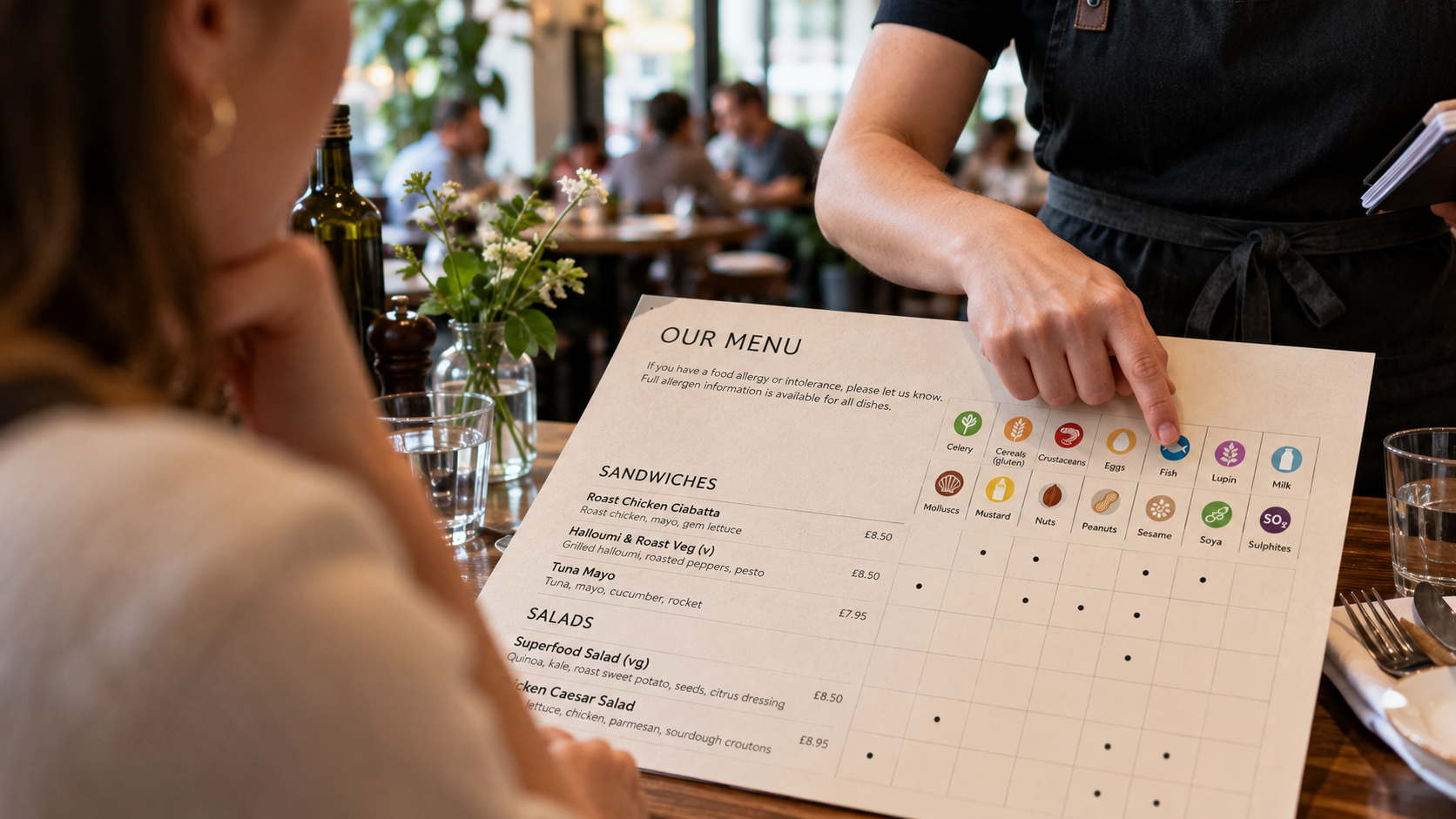
Non-prepacked food still needs allergen information, just not this label. PPDS sold online or by phone is still PPDS: it's exempt from the label, not from allergen information.
What goes on a PPDS label
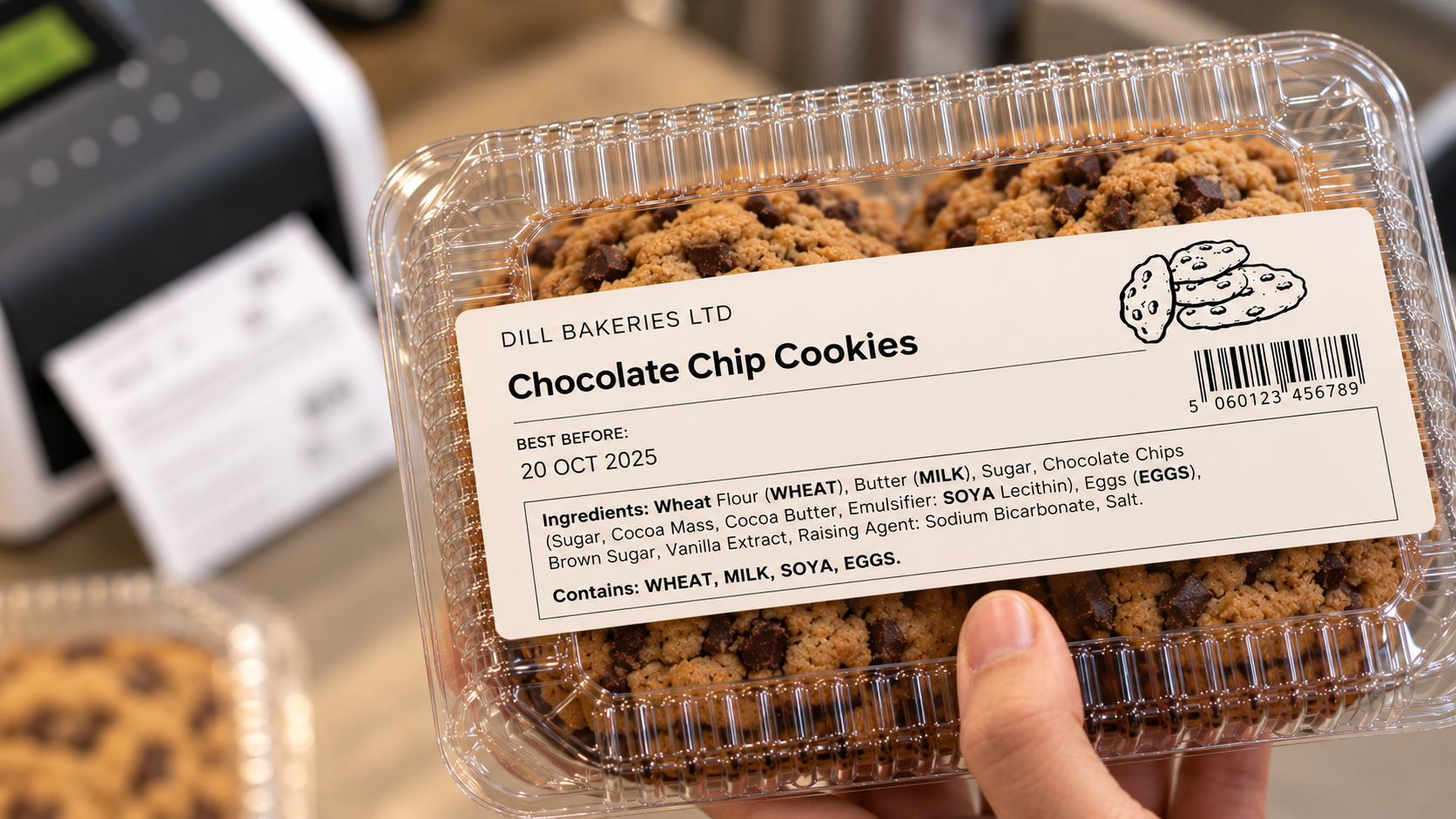
The FSA: "The label needs to show the name of the food and the ingredients list with the 14 allergens required to be declared by law emphasised within it."
- Name of the food.
- Full ingredients list. Every ingredient, not just the allergens.
- The 14 allergens emphasised. Bold type, capital letters, contrasting colours or underlining all work. The 14: celery, cereals containing gluten, crustaceans, eggs, fish, lupin, milk, molluscs, mustard, peanuts, sesame, soybeans, sulphur dioxide/sulphites (above 10mg/kg or 10mg/litre) and tree nuts.
- Legible text. The minimum x-height is 1.2 mm, or 0.9 mm if the pack's largest surface is under 80 cm². That's Article 13 of Regulation 1169/2011, which regulation 5A applies to PPDS.
You also still have to meet any other labelling rules for your nation. The business that packs the food is responsible for its label.
The 07:30 sandwich:
Free-Range Egg Mayonnaise Sandwich
Ingredients: Bread (WHEAT flour, water, yeast, salt, SOYA flour), free-range EGG (40%), mayonnaise (rapeseed oil, EGG yolk, spirit vinegar, MUSTARD seed, salt), cress.
Made: 05/10 · Use by: 06/10 · By: AC
(Ingredients illustrative.)
The name and ingredients with emphasised allergens are the PPDS part. The dates and initials are good practice. The 08:15 made-to-order sandwich needs no label, but the customer must still be able to get allergen information.
A burger van, boxing burgers at 11:45 before the lunch queue:
Beef Burger with Cheese
Ingredients: Brioche bun (WHEAT flour, water, EGG, butter (MILK), sugar, yeast, salt, SESAME seeds), beef patty (beef, salt, black pepper), cheese slice (MILK), burger sauce (rapeseed oil, EGG yolk, spirit vinegar, MUSTARD, salt).
Packed: 05/10 · 11:45 · By: RT
(Ingredients illustrative.)
Once burgers are wrapped to order, they're non-prepacked. The FSA's technical guidance says "a freshly prepared sandwich or burger that is made and wrapped after taking an order" is not PPDS food (FSA technical guidance). A menu board or allergen matrix covers that instead.
Tricky cases
Free samples. Free cookie samples packed on site are PPDS. Free doesn't mean exempt.
Vans and stalls. If you sell from a market stall or van and "you package this food yourself at a different location, this is PPDS food".
Same-site units. Food Standards Scotland describes "same site" as a building complex, such as a shopping centre or airport terminal. Food packed in one unit and sold in your own unit in the same station, hospital, university or holiday park is PPDS.
A central kitchen supplying shops at other addresses. Official guidance doesn't address this directly. The FSA definition points to it falling outside PPDS and most likely being full prepacked food, which needs more on the label (date marks, business name and address, net quantity). Check with your local authority.
Hampers and gift boxes. No official PPDS guidance. It likely depends on who packed each item and when the hamper was assembled. Ask your local authority.
Click-and-collect and delivery. PPDS sold online or by phone is exempt from the label, but you must give allergen information before the purchase is completed and when the food is delivered. The FSA says it should be available in writing at some point between order and delivery. An online order collected in person isn't clearly covered. See our guide to allergen labelling for delivery orders.
The law in each nation
The rules started across the UK on 1 October 2021. Before that, allergen information for these products could be given any way, including verbally by staff.
- England: The Food Information (Amendment) (England) Regulations 2019, SI 2019/1218.
- Wales: The Food Information (Wales) (Amendment) (No. 2) Regulations 2020, SI 2020/295 (W. 67).
- Northern Ireland: The Food Information (Amendment No. 2) Regulations (Northern Ireland) 2020, SR 2020/80.
- Scotland: The Food Information (Scotland) Amendment Regulations 2021, SSI 2021/70.
In England, SI 2019/1218 added regulation 5A (ingredients and allergens on the package or an attached label) and regulation 6A (name of the food) to the Food Information Regulations 2014. Full detail in our Natasha's Law and PPDS guide.
Enforcement and penalties
In England:
- Failing to declare allergens, emphasised, on PPDS food is a criminal offence under regulation 10 of the Food Information Regulations 2014.
- The penalty on summary conviction is "a fine not exceeding level 5 on the standard scale" (FIR 2014, regulation 11). In England and Wales, level 5 fines have been unlimited since 2015. Scotland and Northern Ireland cap level 5, so "unlimited" isn't true UK-wide.
- Officers can serve improvement notices for missing ingredients, allergens or name. Ignoring a notice is an offence.
The FSA's technical guidance mentions a "potentially unlimited fine" for offences under the Food Information Regulations 2014, which apply in England.
A PPDS checklist
- List every product packed before it's ordered, including samples and anything boxed ahead of a rush.
- Run each through the three-question test.
- Write the full ingredients list, including sub-ingredients like the mayo.
- Emphasise the 14 allergens the same way every time.
- Check text is at least 1.2 mm x-height, or 0.9 mm on packs whose largest surface is under 80 cm².
- Re-label whenever a recipe or supplier changes.
- For online and phone orders, give allergen information before purchase and at delivery, with it available in writing in between.
What's still unclear
- Central kitchens supplying other addresses, hampers and click-and-collect, as above.
- Free food beyond samples, such as at events or staff canteens.
When in doubt, call your local authority.
How Dill handles it
With Dill, recipes, ingredients, allergens and shelf lives sit in one place. Staff pick the item on a tablet or phone and the label prints with the right allergens, dates and who made it. Change a recipe once and every site gets it. Products come across from your POS or EPOS data (Clover, Lightspeed, EposNow, CyBake, PosHub), so nobody retypes the menu.
It prints grab-and-go, made-to-order and prep and rotation labels, so food to go allergen labelling sits alongside the rest of your labels. It runs on Brother label printers, with other hardware on request. It's used by hundreds of businesses, thousands of sites between them, with over 65 million labels printed.
Label the 07:30 sandwiches properly
If your fridge fills up before you open, we'll show you how Dill labels every box the same way. Book a demo.
FAQ
What does PPDS stand for?
Prepacked for direct sale: food packed by a business where it's sold, before the customer orders or selects it.
Is PPDS the same as Natasha's Law?
The FSA says the PPDS allergen labelling requirements are "also known as Natasha's Law". They started on 1 October 2021. PPDS is the category of food; the law sets what its label must show.
What must be on a PPDS label?
The name of the food and a full ingredients list with the 14 allergens emphasised, for example in bold capitals. Other labelling rules for your nation still apply.
Are free samples PPDS?
Yes, if they're packed on site before they're handed out. Free doesn't mean exempt.
Is a sandwich made to order PPDS?
No. Food packed after the customer orders is non-prepacked. You still need to give allergen information.
Do I need a PPDS label for online orders?
No, but you must give allergen information before the purchase is completed and when the food is delivered.
Does PPDS apply to food vans?
Yes, if you pack the food before it's ordered, including packing it elsewhere and selling it from your van or stall.